The highest honor for a crew that crossed lunar distance
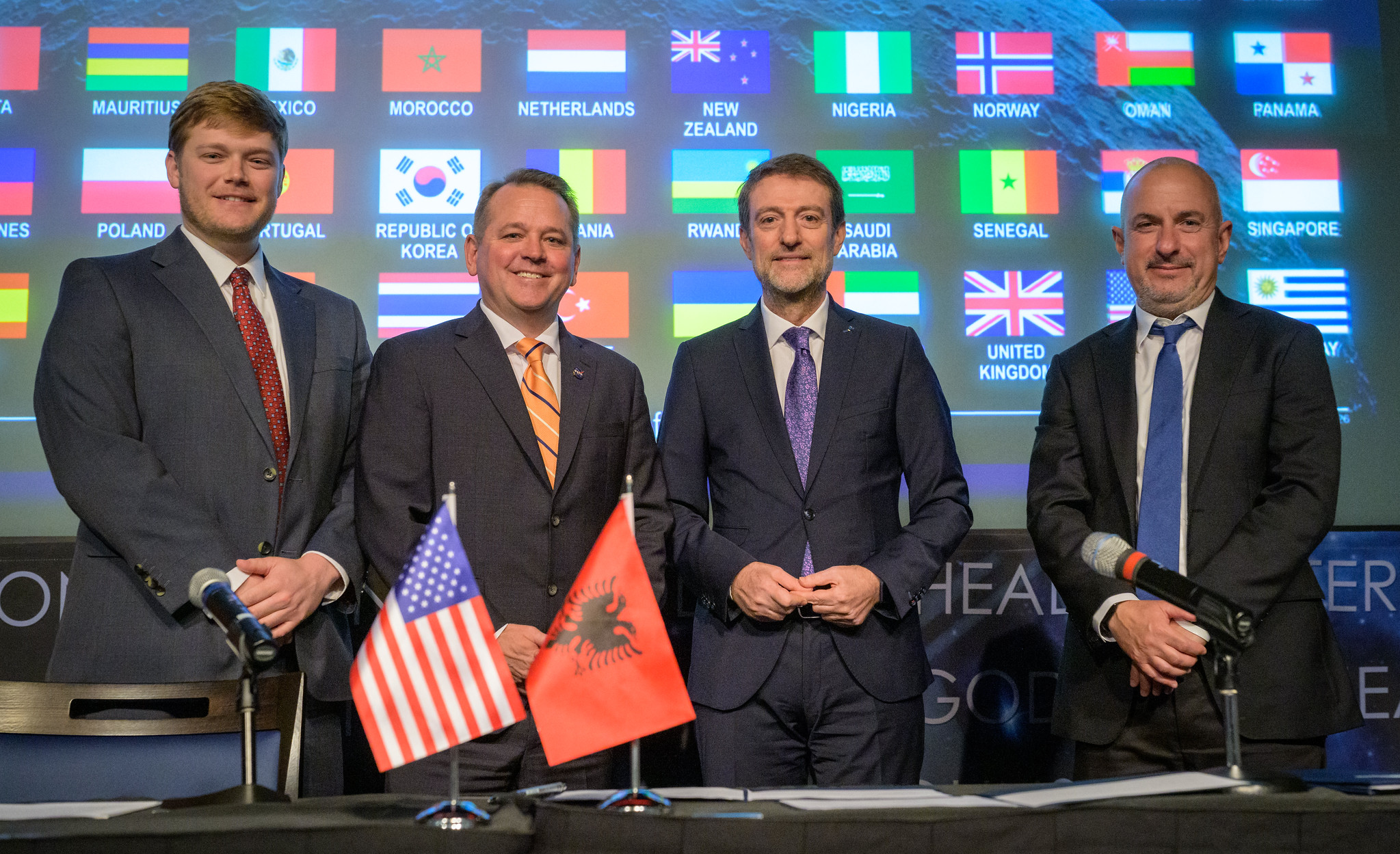
On Friday, August 28, 2026, President Donald Trump traveled to NASA's Johnson Space Center in Houston to preside over a ceremony recognizing the four astronauts who flew aboard Artemis II. NASA astronauts Reid Wiseman, Victor Glover, and Christina Koch, along with Canadian Space Agency astronaut Jeremy Hansen, each received the Congressional Space Medal of Honor — the most prestigious civilian award the United States bestows in the field of space exploration.
The decoration of Jeremy Hansen carries particular weight: he becomes the first non-American astronaut to receive this distinction, a gesture that underscores the genuine partnership binding NASA to its international allies within the Artemis framework. Artemis II marked humanity's return to the vicinity of the Moon for the first time since the Apollo era, and the crew's four members are now formally recognized as part of that milestone.
An executive order to build the workforce of the future
The ceremony did more than look back. President Trump used the occasion to sign an executive order directing the creation of the first-ever U.S. Space Academy, a federally established institution to be led by NASA. The stated purpose is to cultivate the engineers, scientists, and professionals who will staff American space programs in the decades ahead.
According to the order, the academy is meant to « encourage and guide » students toward space-related careers, anchored around four domains identified as strategically critical: national security, economic growth, scientific discovery, and technological innovation. The language of the document frames space as a sovereign priority — a domain where American leadership must be deliberately built and sustained, not assumed.
Many specifics remain undisclosed at this stage, including the academy's location, its curriculum structure, funding mechanisms, and implementation timeline. NASA will coordinate the effort, likely in conjunction with the Department of Defense and other relevant federal bodies. Whether the institution will more closely resemble a civilian university or carry a military-style mission profile is also yet to be defined publicly.
A policy statement with long-term implications
Both announcements fit within a broader pattern. Since returning to office, the Trump administration has consistently framed space as a domain of American primacy, backing NASA's crewed exploration agenda, expressing interest in lunar resources, and supporting the expansion of orbital defense capabilities through the United States Space Force.
A federal Space Academy draws a conceptual parallel to institutions like the United States Military Academy at West Point or the Naval Academy in Annapolis — long-standing pipelines for national leadership in their respective domains. Applied to space, such a structure could serve both the deep exploration ambitions of NASA and the operational requirements of Space Force, the military branch established in 2019.
Whether this executive order translates swiftly into a functioning institution is a fair question. The gap between presidential directives and operational reality in large federal undertakings can stretch across years and budget cycles. For now, the order sends a clear signal about where the administration wants the country's space priorities to point — even if the road from signal to structure is rarely a straight one.