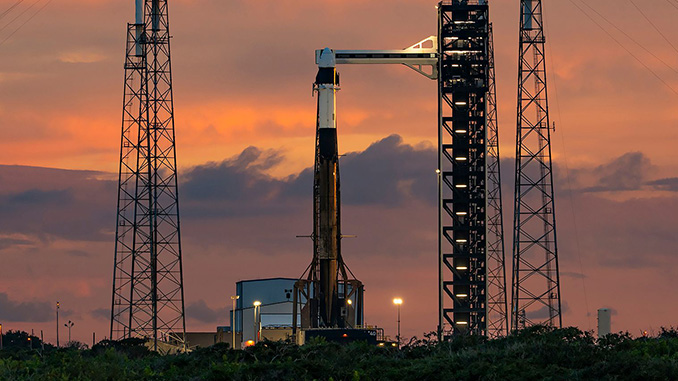
A brief delay, then a clean ascent
After being pushed back by approximately 24 hours, SpaceX's Cargo Dragon lifted off from Space Launch Complex 40 at Cape Canaveral Space Force Station in Florida on Friday, May 15, 2026, at 6:05 p.m. EDT — or 22:05 UTC. The Falcon 9 rocket carried the capsule, loaded with close to 6,500 pounds of cargo, into orbit on a trajectory toward the International Space Station. The precise reason for the initial delay has not been officially confirmed, though single-day postponements in orbital operations are typically tied to weather constraints or late-stage technical checks.
True to SpaceX's standard practice, the Falcon 9 first stage completed a successful recovery landing after stage separation, continuing the booster reusability cycle that has become a hallmark of the company's commercial launch cadence. The Dragon capsule continued its solo flight toward the station, with docking scheduled within the first day following launch.
Science at the heart of the cargo manifest
NASA emphasized the scientific weight of this particular delivery. Among the nearly three tonnes of freight, a significant portion consists of new research experiments slated for execution aboard the orbiting laboratory. While NASA has not released a comprehensive breakdown of the scientific manifest, missions of this type typically include payloads focused on microgravity biology, fluid physics, and the behavior of materials in the space environment.
Beyond the laboratory hardware, Expedition 74 crew members were also awaiting standard logistical supplies: food, spare parts, and maintenance equipment. These items may lack scientific glamour, but they are fundamental to keeping the station operational on a day-to-day basis. It is worth noting that the Russian cargo spacecraft Progress MS-34 had docked with the ISS roughly two weeks prior to CRS-34's arrival, maintaining an uninterrupted resupply chain to the outpost.
Thirty-four missions in — and the work continues
CRS-34 marks the latest chapter in a commercial partnership between SpaceX and NASA that stretches back to 2012, when the first Dragon cargo mission demonstrated that private industry could reliably service the ISS. Over more than a decade, the upgraded Cargo Dragon has become the primary American resupply vehicle for the station, alongside Northrop Grumman's Cygnus spacecraft.
The near-routine nature of these missions should not obscure the broader context surrounding the ISS. The station is formally scheduled for deorbit in the late 2030s, and discussions about next-generation commercial low-Earth-orbit platforms are gaining momentum. Each CRS flight helps sustain a laboratory operating on borrowed time while also validating the logistical competencies that future orbital infrastructure will demand. Meanwhile, SpaceX is simultaneously advancing on a very different front: the twelfth integrated test flight of Starship is on the horizon, representing the next evolutionary step for a vehicle designed to reshape deep-space transportation entirely.