A six-meter shield built for the cold of space
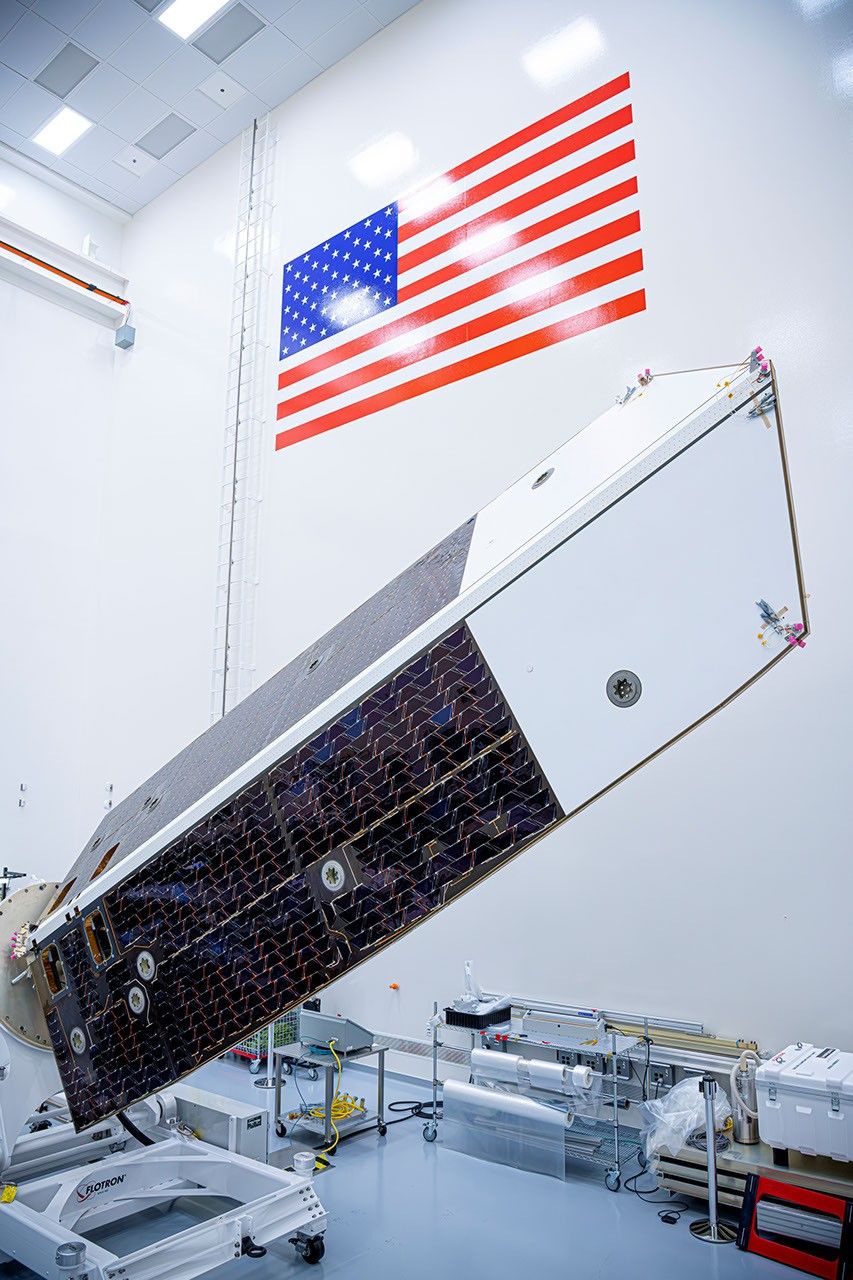
Inside a clean room at BAE Systems Space & Mission Systems in Boulder, Colorado, technicians spent part of this past summer scrutinizing the primary sunshade of NEO Surveyor, NASA's forthcoming infrared space telescope designed to track near-Earth objects. The structure stands roughly six meters tall and spans about 2.4 meters at its base. Mounted on an assembly ring, it underwent a thorough series of mechanical and visual checks as the spacecraft's integration campaign continued.
The sunshade is far more than a protective shroud. For an infrared telescope like NEO Surveyor, keeping the detector arrays at cryogenic temperatures is a prerequisite for any useful science. Direct exposure to sunlight would overwhelm the sensors with thermal noise, effectively blinding them to the faint heat signatures of distant asteroids. The sunshade solves this by permanently blocking solar radiation from reaching the instrument payload, allowing the detectors to operate at the extreme cold they require.
A multi-state manufacturing effort
The sunshade's production involved a chain of specialized contractors spread across the American West. The core structure was fabricated by Applied Aerospace in Stockton, California. Early this year, the assembly traveled to Albuquerque, New Mexico, where SolAero Technologies bonded photovoltaic cells onto the structure's two flat panel surfaces. Those cells will serve as the spacecraft's primary power source once it reaches its operational orbit.
The completed sunshade then moved to BAE Systems in Boulder for the current phase of inspections and integration work. There, engineers are verifying that every component meets the structural and environmental requirements demanded by a deep-space mission — including resistance to the vibrations of launch and the thermal extremes of cislunar space. This kind of rigorous qualification process is standard for flagship-class NASA science missions, where hardware replacement after launch is simply not an option.
Planetary defense as policy and engineering priority
NEO Surveyor exists because a gap remains in humanity's knowledge of the near-Earth object population. A congressional mandate charges NASA with cataloguing at least 90 percent of near-Earth objects larger than 140 meters in diameter — bodies large enough that a collision with Earth could cause regional-scale destruction. Ground-based surveys, while valuable, are inherently limited by atmospheric interference and the difficulty of observing objects that approach from the direction of the Sun.
Operating from the Sun-Earth L1 Lagrange point, roughly 1.5 million kilometers from Earth, NEO Surveyor will have a vantage point unavailable to any ground telescope. Its infrared cameras will detect asteroids by their thermal emission rather than reflected sunlight, making it effective even for dark-surfaced objects that conventional optical telescopes tend to miss.
NASA has not publicly confirmed a firm launch date at this stage, though the visible momentum in hardware assembly suggests the program is progressing steadily. For planetary defense advocates and the broader scientific community, NEO Surveyor represents the most direct investment yet in giving Earth adequate warning time — should it ever be needed.