SpaceX sustains its operational pace on two coasts
Mid-October brought another demonstration of SpaceX's ability to maintain a high launch tempo across multiple sites. On October 15, a Falcon 9 lifted off from pad 4E at Vandenberg Space Force Base in California, carrying a classified payload for the U.S. Space Force. With liftoff timed at 11:57 p.m. UTC, few details were disclosed beyond the mission's government customer — standard practice for sensitive national security flights. SpaceX has become the default heavy lifter for U.S. military orbital needs, a position it consolidates with each successive dedicated government launch.
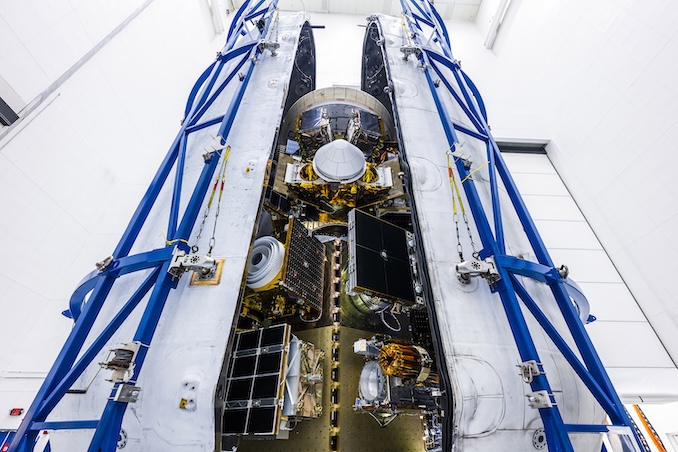
Days later, attention shifted to Florida, where pad 40 at Cape Canaveral Space Force Station was set to host the Bandwagon-5 rideshare mission. With a one-hour launch window opening at 10:30 UTC, the flight carries 31 customer payloads — another reflection of how the small satellite market has matured into a structured, multi-customer economy built around shared-ride services.
The headline passenger on Bandwagon-5, however, is Starfall, SpaceX's uncrewed atmospheric reentry capsule. Flying for only the second time, Starfall remains a maturing demonstrator rather than an operational system, but its purpose is commercially significant: recovering payloads from low Earth orbit. That capability has been largely absent from Western spaceflight since the era of Russian Foton capsules, and its revival could open new avenues for in-space manufacturing and experiment return.
JAXA targets Phobos in a landmark sample-return bid
While SpaceX focused on Earth orbit, the Japan Aerospace Exploration Agency was preparing for something far more distant. JAXA's MMX mission — Martian Moons eXploration — was on track for launch early in the week of October 20, targeting Phobos, the larger of Mars's two small moons.
MMX is designed to do what no mission has done before: land on Phobos, collect surface material, and return those samples to Earth. The scientific stakes are substantial. Phobos's origin remains genuinely uncertain — the captured asteroid hypothesis and in-situ accretion models both have supporters — and physical samples could settle the debate while also informing our broader understanding of the early solar system.
NASA is contributing two scientific instruments to the spacecraft, deepening a collaborative arrangement that reflects an increasingly common model for planetary science: rather than duplicating expensive hardware, agencies pool expertise across national boundaries. The JAXA-NASA partnership on MMX follows a pattern similar to the joint work seen on missions like Mars Odyssey or the Europa Clipper instrument suite.
Two timescales, one industry
Taken together, these three missions offer a snapshot of where spaceflight stands in late 2026. SpaceX's back-to-back launches — one for a classified government customer, one stacking 31 commercial payloads alongside a reentry demonstrator — illustrate just how routine orbital access has become for the private sector. Turnaround times, manifest flexibility, and dual-coast operations would have seemed exceptional a decade ago; today they are simply the business model.
MMX operates on a different clock entirely. Years of development, a journey measured in hundreds of millions of kilometers, and a sample canister that won't touch down on Earth until the early 2030s. Both rhythms are valid, and both are necessary. The more interesting question going forward may be how the commercial cadence and the institutional long game continue to intersect — and whether the boundaries between them will remain as clear as they appear today.