Clouds at dusk on another world
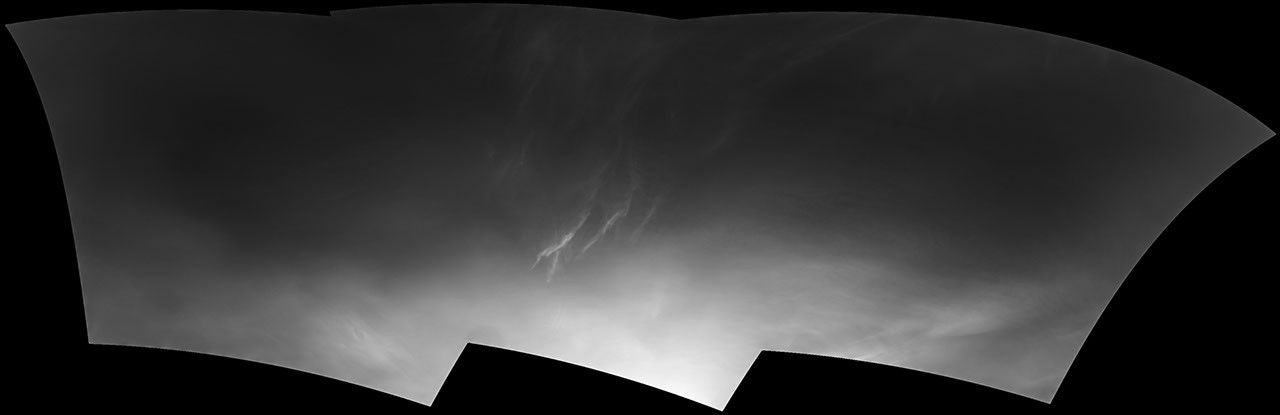
On October 31, 2026 — sol 5,061 of its mission — NASA's Curiosity rover turned its navigation cameras skyward shortly after sunset and recorded something that only appears for a brief window each Martian autumn: drifting twilight clouds above Gale Crater. These high-altitude formations catch the last oblique rays of sunlight while the ground below has already fallen into darkness, creating a faint but detectable glow that Curiosity's cameras can track across successive frames.
The scientific interest goes well beyond the visual. Mars has an atmosphere roughly one hundred times thinner than Earth's, and understanding how clouds form, move, and dissipate within it is essential for building accurate climate models. Whether these particular clouds are composed of water-ice crystals, CO₂ ice, or suspended dust remains an open question — Curiosity carries no lidar to probe their structure directly — but the sequential imagery allows researchers to estimate drift speeds and approximate altitudes, feeding data into atmospheric simulations developed at the Jet Propulsion Laboratory (JPL) and partner institutions.
Forty-nine holes in Martian rock
A few weeks later, on November 16, 2026, NASA released a composite image cataloguing all 49 drill holes Curiosity has made since touching down in August 2012. Each circular bore, typically a few centimeters wide and roughly six centimeters deep, was produced by the percussive drill mounted at the end of the rover's robotic arm. The pulverized rock is then funneled into two onboard laboratories: CheMin, which uses X-ray diffraction to identify minerals, and SAM (Sample Analysis at Mars), which searches for organic molecules and isotopic signatures relevant to habitability.
Laid out in sequence, those 49 holes trace a geological journey through deep time. The earliest samples came from clay-bearing mudstones near the crater floor — sediments deposited in the presence of liquid water billions of years ago. More recent drillings have tapped into sulfate-rich layers higher up the foothills of Mount Sharp, recording the planet's gradual transition toward the hyper-arid environment it displays today. Every hole is, in effect, a data point on a planetary climate curve that scientists are still learning to read.
Operating well beyond design life
Curiosity was originally certified for a two-year primary mission. It has now been active on the Martian surface for over fourteen years, a longevity that transforms the rover itself into an engineering case study. How do precision instruments degrade under sustained cosmic radiation? How does mechanical wear accumulate in a near-vacuum environment with wide daily temperature swings? The JPL operations team continuously revises activity sequences to work around hardware limitations while preserving core scientific capability.
The rover's power source — a radioisotope thermoelectric generator (RTG) fueled by plutonium-238 — loses roughly one percent of its electrical output per year, forcing ever-tighter trade-offs between driving, heating, and running science instruments. How much operational life remains is genuinely uncertain. What is certain is that as long as Curiosity keeps moving and drilling, it will keep adding to a geological record that is fundamentally changing how we think about Mars — and, by extension, about the conditions under which rocky planets can sustain the chemistry of life.