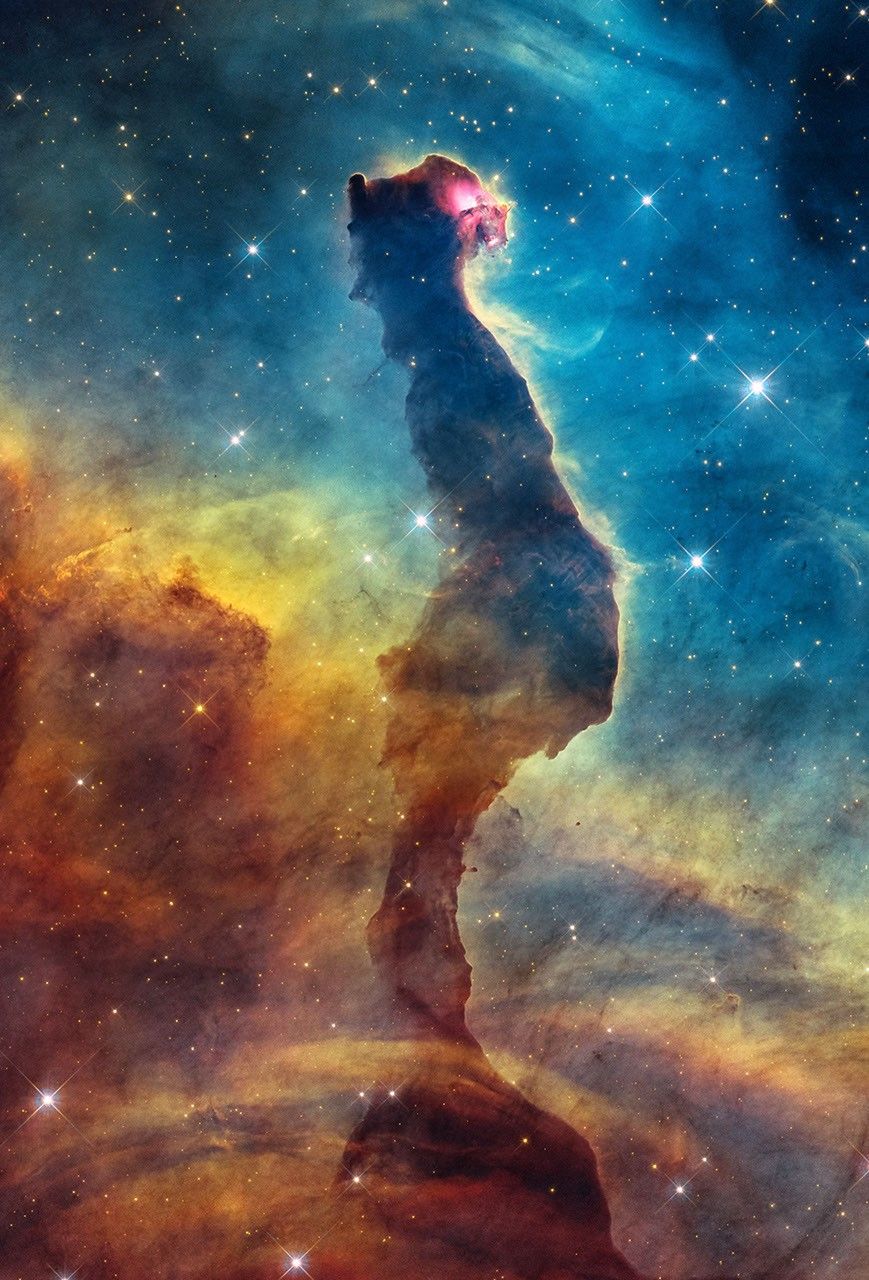
Tucked inside the sprawling gas clouds of the Carina Nebula, roughly 7,500 light-years from Earth, lies a formation that astronomers have taken to calling the Cat's Head Nebula. The name fits: the dark silhouette carved out by dense dust bears an unmistakable resemblance to a feline profile. NASA and ESA have now released imagery from both the Hubble Space Telescope and the James Webb Space Telescope trained on this compact region, producing one of the most detailed multi-wavelength portraits of active star formation to date.
Two telescopes, two layers of the same story
The Carina Nebula is among the most productive stellar nurseries in the Milky Way — a vast reservoir of gas and dust where gravity, radiation pressure, and turbulence conspire to trigger the birth of new stars. The Cat's Head subregion is a particularly striking example of this process in action.
Hubble, observing in visible light, renders the Cat's Head as an elongated dark pillar. The dense dust column absorbs and scatters the surrounding starlight, casting it into shadow. Faint hints of young stellar objects peek through the structure, but the opaque material keeps many details out of reach.
Webb's infrared instruments tell a different story. Infrared wavelengths penetrate dust far more effectively than visible light, stripping away the obscuring veil and exposing a rich population of embedded stars. Where Hubble shows shadow, Webb shows light — young stars whose radiation is actively reshaping the gas around them, along with structural details that visible-light observations simply cannot access.
Complementary by design
This joint observation is a textbook demonstration of why Webb was built the way it was. From its earliest conception, the telescope — developed through a partnership between NASA, ESA, and the Canadian Space Agency (CSA) — was intended to extend rather than replace Hubble's capabilities. Both observatories pointed at the same patch of sky, producing a dataset that neither instrument could have generated alone.
Webb has been conducting science operations since 2022, quickly establishing itself as a transformative tool for infrared astronomy. Hubble, launched in 1990 and serviced multiple times over the decades, remains scientifically productive and continues to complement its newer counterpart in exactly this kind of paired campaign.
The Carina Nebula provides fertile ground for this type of collaborative observation. It hosts some of the most massive and luminous stellar systems in the galaxy, and regions like the Cat's Head are precisely where the next generation of stars is taking shape — where interstellar material collapses under its own gravity, nudged along by the intense radiation of neighboring massive stars.
What the science delivers
Beyond their visual appeal, these combined images carry real scientific weight. Cross-referencing Hubble's visible-light data with Webb's infrared imagery allows researchers to map dust distribution with greater precision, probe the temperature of ionized regions, and identify young stellar objects still embedded deep within the pillar — objects that have no visible-light signature whatsoever.
Previous Webb observations of other areas within the Carina Nebula have already surfaced protostars and nascent protoplanetary disks — structures that could eventually evolve into planetary systems not unlike our own. The Cat's Head may well hold comparable discoveries waiting to be extracted from the data.
The broader picture that emerges from observations like these is one of continuity: the same physical processes that built the Sun some five billion years ago are still at work today, playing out in real time across regions like this one. Hubble and Webb, working together, are giving astronomers the tools to read that story with unprecedented clarity.