A Ghost Galaxy Hiding in Canis Major
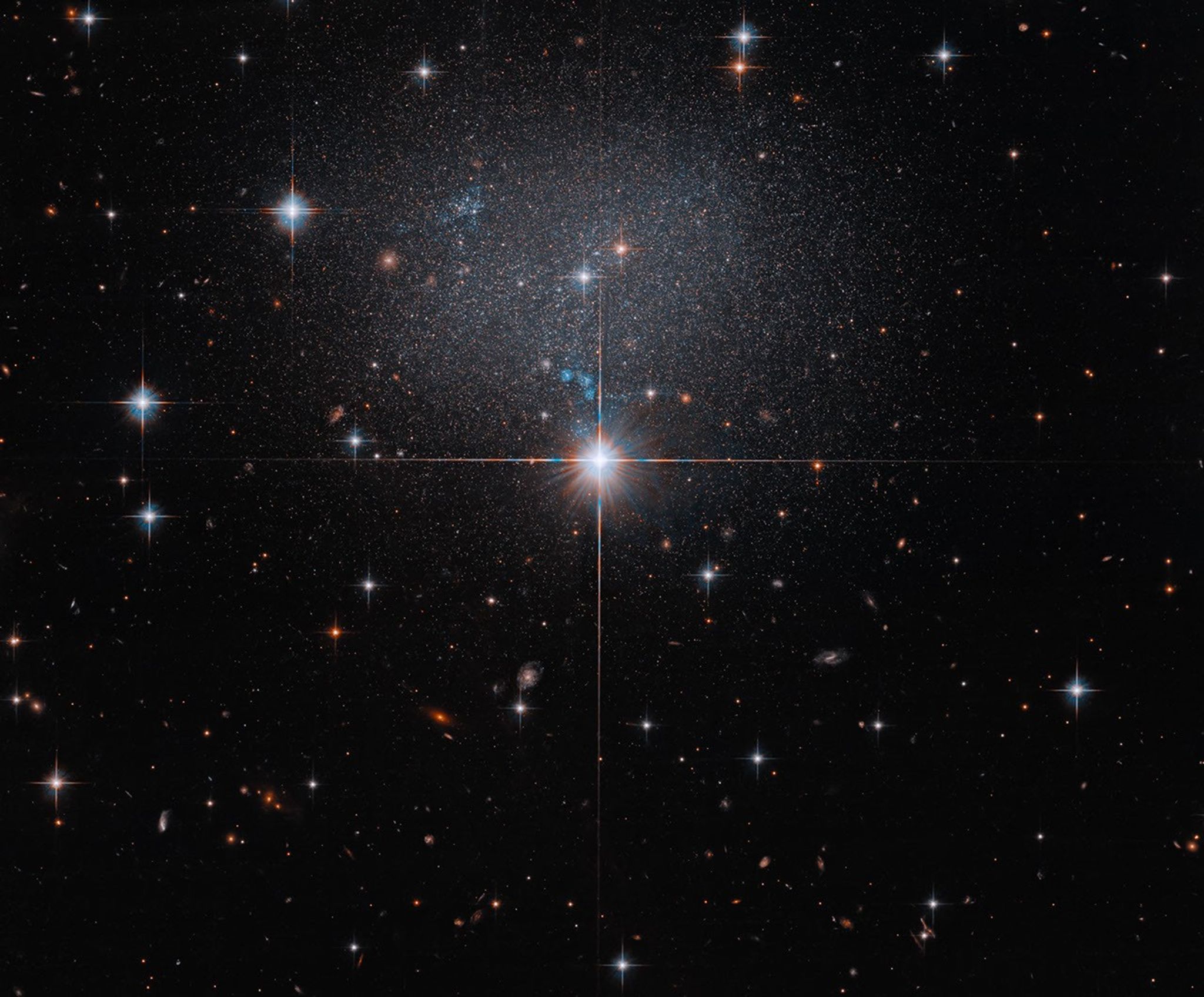
On May 27, 2026, NASA released a Hubble Space Telescope image showcasing ESO 490-017, a dwarf irregular galaxy sitting roughly 23 million light-years away in the constellation Canis Major. Spanning only about 12,000 light-years across, it ranks among the smaller galaxies accessible to modern observatories. Its defining characteristic is an exceptionally low surface brightness — the galaxy appears as little more than a faint, dispersed haze of stars on the Hubble frame, nearly overwhelmed by the glare of foreground stars whose diffraction spikes mark them as objects within our own Milky Way.
Irregular dwarf galaxies like ESO 490-017 resist easy classification. They lack the orderly spiral arms or smooth ellipsoidal profiles of their larger cousins, and their chaotic appearance often reflects a turbulent history — past gravitational encounters, uneven bursts of star formation, or simply a primitive structure that never evolved into a more organized form. For astronomers, these so-called low surface brightness galaxies are scientifically valuable precisely because they are hard to find: their undisturbed nature preserves clues about early cosmic conditions. Hubble remains one of the few facilities capable of resolving such objects in enough detail to extract meaningful physical data.
Messier 88 and the Long Fall Toward the Virgo Cluster
Just hours earlier, both NASA and ESA turned attention to a very different kind of galaxy: Messier 88, an active spiral located approximately 63 million light-years away. Where ESO 490-017 is faint and formless, M88 is a textbook example of a well-defined spiral system. Its tightly wound arms are clearly visible in Hubble imagery, and its core hosts an active galactic nucleus — meaning the central supermassive black hole is actively drawing in surrounding material and releasing energy in the process.
What makes M88 particularly compelling from a dynamics perspective is its current journey. The galaxy is falling inward toward the gravitational center of the Virgo Cluster, the largest nearby concentration of galaxies and the dominant structure in our cosmic neighborhood. As it moves through the hot, diffuse gas that pervades the cluster, M88 is experiencing ram pressure stripping — a process in which the intergalactic medium sweeps interstellar gas away from the galaxy's disk, progressively depriving it of the raw material needed to form new stars. Over time, this mechanism can effectively shut down star formation, transforming a gas-rich spiral into a quiescent system.
One Telescope, Two Very Different Stories
The near-simultaneous release of these two images is a reminder that Hubble, now more than three decades into its mission, continues to operate across a remarkably wide scientific range. Detecting the diffuse glow of a low-brightness dwarf galaxy demands precision at the faint end of photometric sensitivity. Tracking the structural evolution of an active spiral within a massive cluster requires a different set of capabilities — sharp resolution, multi-wavelength coverage, and the ability to track changes across time.
As the James Webb Space Telescope claims much of the current spotlight with its infrared views of the early universe, Hubble maintains an essential and complementary role in optical and ultraviolet astronomy. These two May 2026 releases make that case quietly but clearly. How much longer the telescope can sustain this level of output remains an open question — but for now, it is still delivering.