A critical optic cleared for the next phase
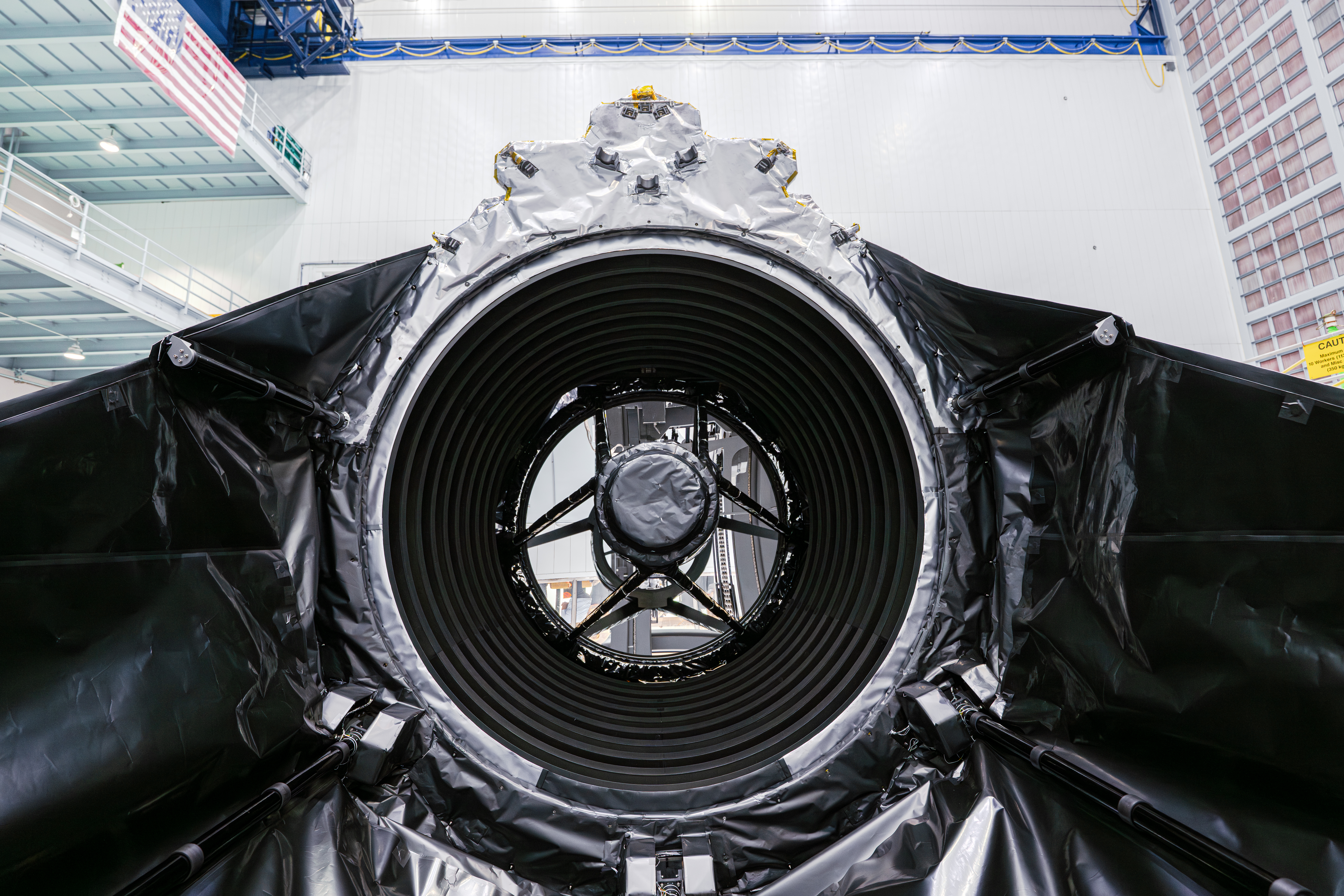
Engineers at NASA's Goddard Space Flight Center in Greenbelt, Maryland, have completed a thorough final inspection of the primary mirror destined for the Nancy Grace Roman Space Telescope. Measuring 2.4 meters across — the same diameter as the Hubble Space Telescope's main mirror — this finely polished optic is responsible for gathering and focusing light from cosmic sources spread across wide swaths of the sky, from nearby stellar populations to distant galaxies billions of light-years away.
The inspection marks the close of an intensive quality assurance phase. Engineers scrutinized the mirror's surface to verify that its shape and polish meet the extremely tight tolerances demanded of a space-based optical instrument. Any deviation beyond specified limits could degrade image sharpness across Roman's field of view, which is designed to be sixty times broader than that of Hubble's Advanced Camera for Surveys — one of the telescope's defining characteristics.
Designed to survey the universe, not just sample it
The telescope is named after Nancy Grace Roman, NASA's first Chief of Astronomy and one of the key figures behind the establishment of the Hubble program. True to that legacy, the Roman Space Telescope is built around the idea of mapping the universe at scale, rather than staring deeply at isolated targets.
Its scientific agenda spans several major pillars of modern astrophysics:
- Mapping the distribution of dark matter through weak gravitational lensing across hundreds of millions of galaxies
- Constraining the nature of dark energy by cataloguing tens of thousands of Type Ia supernovae
- Detecting exoplanets through gravitational microlensing toward the galactic bulge
- Tracing the formation and evolution of galaxies across cosmic time
At the heart of Roman's observational power sits the Wide Field Instrument, a 300-megapixel mosaic detector capable of imaging a patch of sky roughly equivalent to two full moons in a single exposure, at a resolution comparable to Hubble's.
Assembly progressing toward environmental testing
The completion of the primary mirror's final inspection fits into a broader integration schedule that is steadily gaining momentum at Goddard. Individual subsystems are being brought together in sequence, ahead of the environmental test campaigns — acoustic, vibration, and thermal-vacuum — that simulate the mechanical stresses of launch and the harsh conditions of orbital operations.
NASA has not announced a firm launch date for Roman, though the mission is targeting a window in the latter half of this decade. The launch vehicle has not been officially confirmed either. What is clear is that Roman is on a trajectory toward deployment at the Sun-Earth Lagrange point L2, located approximately 1.5 million kilometers from Earth — the same operational station as the James Webb Space Telescope.
The two observatories are not competitors. Webb operates primarily in the mid- and far-infrared, peering deep into narrow fields with extraordinary sensitivity. Roman will work in the near-infrared and visible, sweeping broad areas of the sky to build statistical datasets that no targeted observatory could assemble. Together, they represent complementary windows onto the same cosmos — one intimate, one panoramic.