An M-class flare: when the Sun makes itself heard
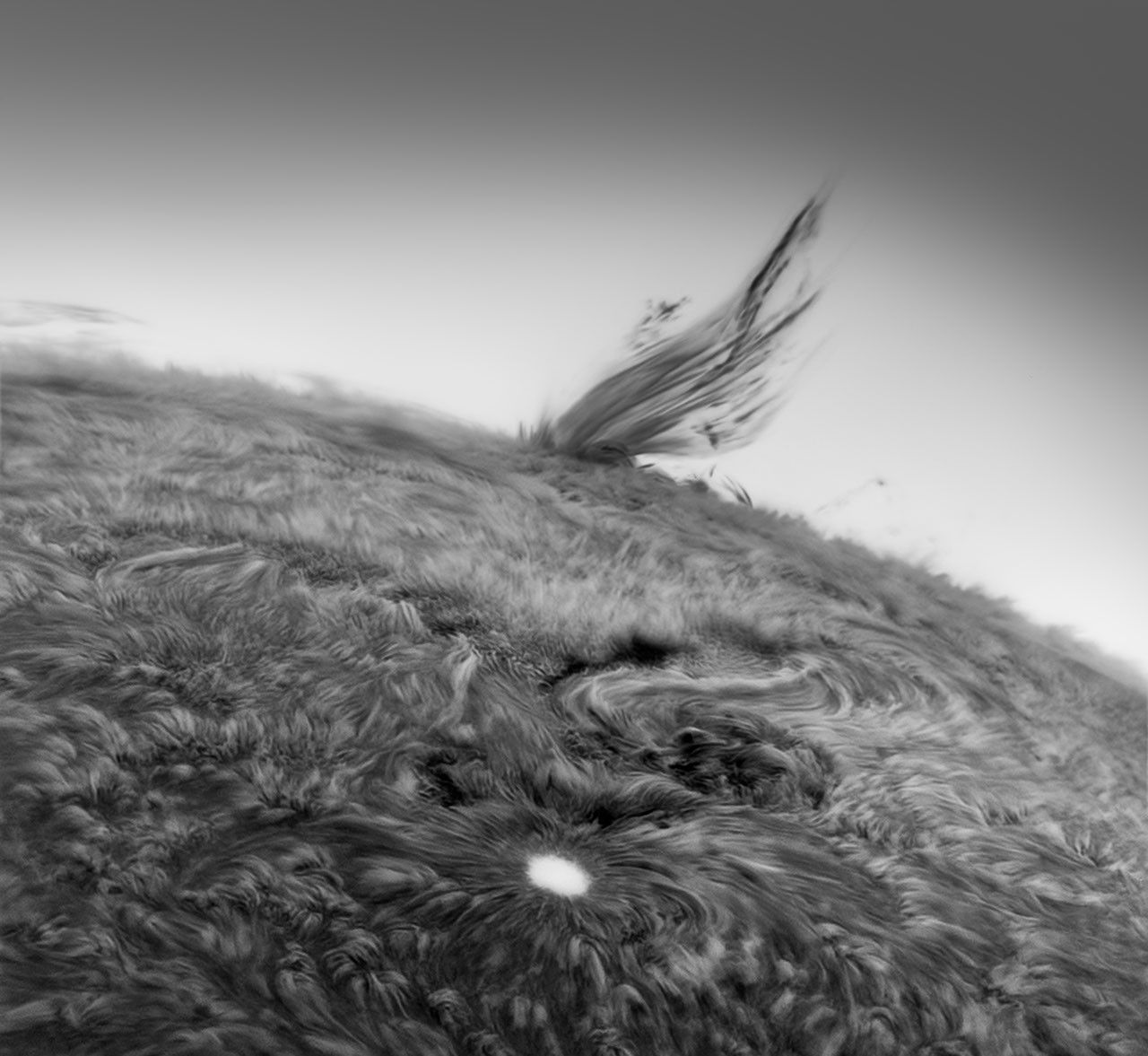
On November 18, 2026, NASA featured an M-class solar flare as its Astronomy Picture of the Day, drawing attention to one of our star's more forceful moods. M-class events sit in the middle of the standard solar flare classification scale — more energetic than the relatively mild C-class flares that occur routinely, but a step below the X-class events capable of causing widespread radio blackouts and significant disruption to satellites in Earth orbit.
Even so, M-class flares are far from trivial. They can trigger minor geomagnetic storms, produce elevated radiation levels along polar flight paths, and generate auroral displays at latitudes where they would not normally be visible. During Solar Cycle 25, which has proven more active than many forecasters initially projected, the Sun has produced a steady stream of such events, keeping space weather agencies on alert.
Missions such as NASA's Solar Dynamics Observatory and ESA's Solar Orbiter continuously monitor the solar surface and corona, providing near-real-time data that helps scientists track active regions and anticipate potential coronal mass ejections before they reach Earth. For crews aboard the International Space Station, and eventually for astronauts on future deep-space missions, this kind of early warning capability is not academic — it is an operational necessity.
NGC 7129: Webb captures star formation in unprecedented detail
Two days earlier, on November 16, the focus shifted from our own solar neighborhood to a stellar nursery in the constellation Cepheus. The nebula NGC 7129, roughly 3,300 light-years from Earth, was imaged by the James Webb Space Telescope, revealing a network of narrow jets streaming away from deeply embedded protostars — stars so young they have not yet shed the dense clouds of gas and dust surrounding them.
These jets, known as Herbig-Haro objects when they collide with surrounding interstellar material, are among the clearest observable signatures of active star formation. Webb's infrared instruments cut through the dust that optical telescopes cannot penetrate, mapping the nursery's inner structure with a level of clarity previously out of reach.
The stars taking shape within NGC 7129 are estimated to be less than one million years old — extraordinarily young by cosmic standards, given that our own Sun has been burning for approximately 4.6 billion years. For astrophysicists, regions like NGC 7129 serve as proxies for the conditions that likely surrounded our solar system in its earliest phase, offering indirect evidence about how planetary systems — including our own — come to be.
APOD at 30: still making the cosmos accessible
Launched in 1995, NASA's Astronomy Picture of the Day program has been publishing daily images accompanied by explanations written by professional astronomers for over three decades. The format is deceptively simple, but its impact on public engagement with astronomy has been considerable, drawing millions of visitors each year from every corner of the world.
The pairing of these two recent images — one rooted in solar physics, the other in stellar astrophysics — reflects the program's breadth and its ability to surface connections across disciplines. A flare on the Sun today and jets from a protostar 3,300 light-years away are, in a sense, different chapters of the same long story: the life cycle of stars, from their turbulent beginnings to the energetic outbursts that mark their active years. How much of that story remains unwritten is precisely what keeps the science moving forward.