Flexell Space and Satoro bet on orbital validation
UK-based solar cell developer Flexell Space and satellite services operator Satoro have signed a cooperation agreement aimed at testing next-generation photovoltaic technology under real orbital conditions. The partnership calls for two dedicated demonstration flights, both launching on SpaceX Falcon 9 rockets — one in 2027 and a follow-up mission in 2028.
The arrangement divides responsibilities along clear lines. Satoro will deliver the satellite platform itself through a Satellite-as-a-service model, handling integration and operations, while Flexell Space will supply its proprietary solar cell modules and the instrumentation needed to capture performance data in flight. The goal is to generate verified, on-orbit measurements that ground-based testing simply cannot replicate — including the effects of sustained radiation exposure and the repeated thermal cycling that occurs each time a spacecraft moves in and out of Earth's shadow.
For companies developing advanced solar cells for commercial markets, in-orbit demonstration has become the de facto threshold for credibility. Operators of low Earth orbit (LEO) constellations are demanding ever-longer satellite lifespans and tighter power budgets, which means vendors who can point to flight-proven hardware hold a significant advantage. The two missions planned by Flexell Space and Satoro are designed precisely to build that track record.
NEO Surveyor's solar panels pass inspection in Colorado
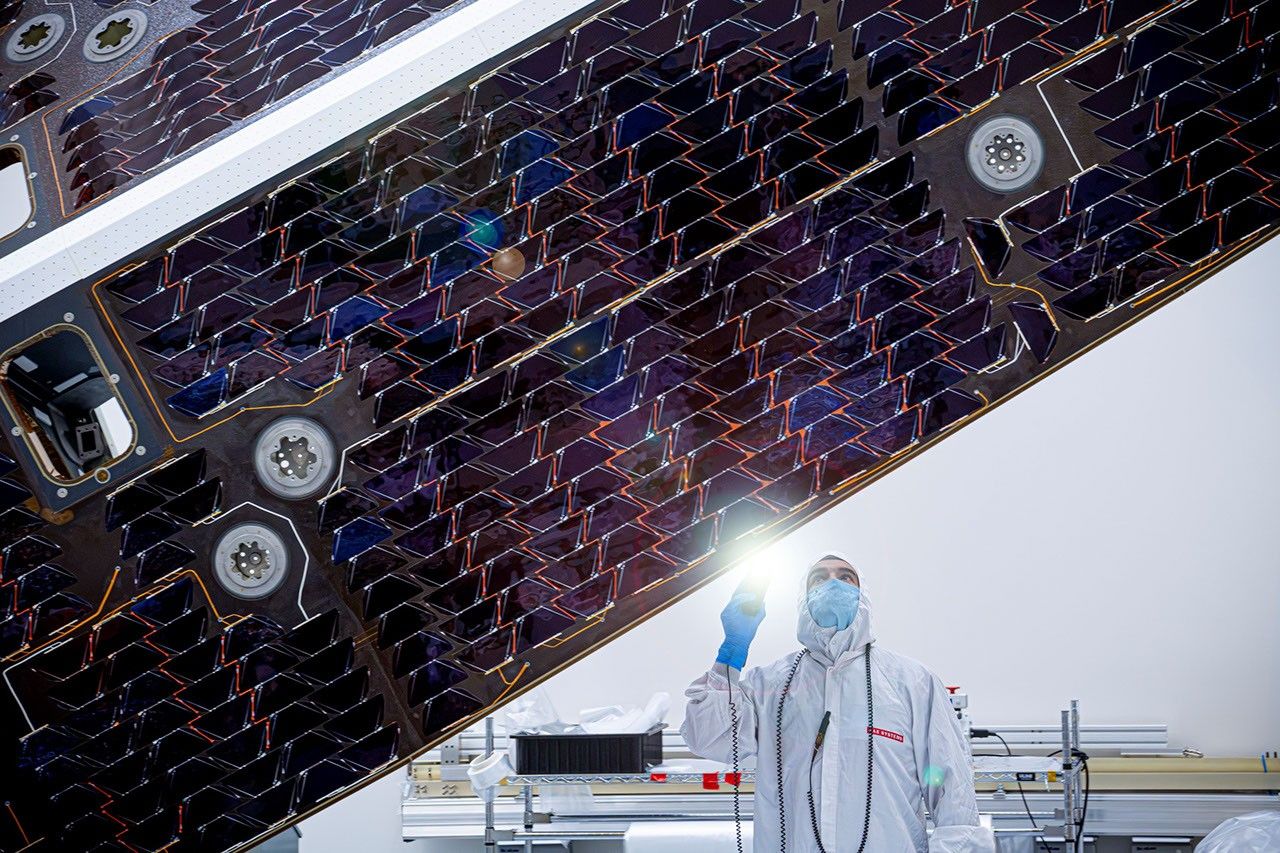
Around the same time, NASA released imagery documenting the inspection of the large sunshade assembly for its NEO Surveyor spacecraft, currently undergoing processing at BAE Systems Space & Mission Systems in Boulder, Colorado. The mission is an infrared space telescope purpose-built for detecting and cataloguing near-Earth objects — asteroids and comets whose trajectories bring them into Earth's neighborhood.
The sunshade structure was manufactured by Applied Aerospace in Stockton, California, and fitted with its solar cell arrays by SolAero Technologies of Albuquerque, New Mexico, earlier in 2026. Those cells will power the spacecraft once it reaches its operational station at the Sun-Earth L1 Lagrange point, roughly 1.5 million kilometers from Earth — a location that offers uninterrupted sunlight but also subjects hardware to a demanding thermal environment over a mission expected to span several years.
Planetary defense is the driving rationale behind NEO Surveyor. Ground-based observatories have significant blind spots when it comes to objects that approach Earth from the direction of the Sun, and the mission is intended to survey populations of potentially hazardous bodies that remain poorly characterized. In that context, the long-term reliability of the solar power system is not a secondary concern — it is foundational to whether the telescope can complete its survey at all.
Two markets, one common challenge
Taken together, these developments point to a broader pattern: space-grade solar cells are under mounting pressure from both the commercial and institutional sides of the industry. LEO mega-constellations are driving demand for cheaper, higher-efficiency cells that can be manufactured at scale. Meanwhile, deep-space and science missions require components that perform consistently across temperature extremes and radiation doses that dwarf anything a terrestrial solar panel ever faces.
That dual pressure is spurring material innovation — alternatives and complements to the gallium arsenide compounds that have dominated space photovoltaics for decades — as well as new module architectures. Whether the catalyst is a startup's orbital demonstration campaign or a NASA planetary defense telescope, the underlying need is the same: solar cells that work harder, last longer, and are trusted enough to carry a mission.