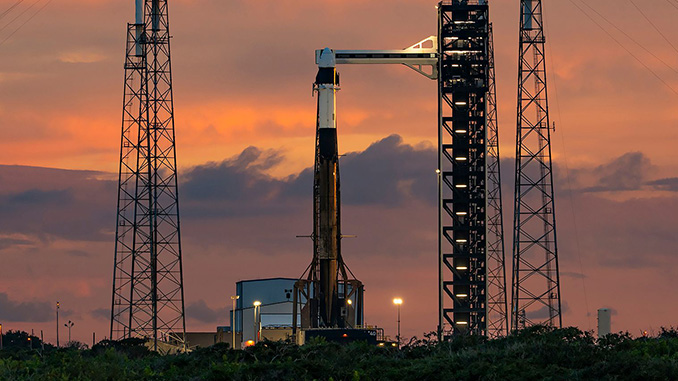
CRS-34: Keeping the ISS stocked for Expedition 74
SpaceX's Dragon spacecraft lifted off on the 34th commercial resupply mission contracted by NASA, carrying roughly 6,500 pounds — approximately 2,950 kilograms — of cargo bound for the International Space Station. The shipment supports the Expedition 74 crew currently living and working aboard the orbiting laboratory.
The manifest follows the established pattern of CRS flights: a combination of food supplies, scientific hardware, and maintenance equipment required to sustain continuous human presence in low Earth orbit. Since the first CRS mission more than a decade ago, the Dragon capsule has become the workhorse of NASA's cargo logistics to the ISS, and this 34th run underscores the reliability that has come to define the partnership.
Dragon is expected to berth with the station within a few days of launch, following a standard orbital approach. As has become routine for SpaceX, the Falcon 9 first stage performed a controlled landing after stage separation, preserving the booster for future flights.
Flight 12: A new chapter for Starship's upper stage
Meanwhile, at SpaceX's Starbase facility in Boca Chica, Texas, engineers are putting the finishing touches on preparations for Starship's twelfth integrated flight test. The mission carries added significance because it is set to mark the flight debut of a substantially redesigned iteration of the vehicle's upper stage, known simply as Ship.
The Ship's design has gone through continuous refinement since the early high-altitude tests of prototype SN8. Each successive campaign has brought changes to the thermal protection system, thrust vector control architecture, and more recently, the hardware required to support full reusability — including the booster and Ship catch attempts performed by the mechanical arms of the launch and integration tower at Starbase.
Flight 12 is expected to put the latest round of modifications to a real-world test. SpaceX has not yet disclosed every technical detail of the changes incorporated into this new Ship variant, though external observers have identified differences in the forward section geometry and the arrangement of the heat shield tiles.
Parallel programs, shared stakes
The timing of these two developments captures something essential about SpaceX's current operational posture: maintaining a high-tempo cadence on proven programs like Falcon 9 and Dragon while simultaneously pressing Starship toward full operational status.
For NASA, both stories carry direct relevance. The agency relies on Dragon to keep the ISS supplied and relies on Starship as the selected Human Landing System for the Artemis program's crewed lunar surface missions. Progress on Starship Flight 12, therefore, has implications that reach well beyond Boca Chica — the timeline for returning astronauts to the Moon is, at least in part, tied to how quickly the vehicle matures.
In the weeks ahead, attention will split between tracking Dragon's docking at the station and watching for SpaceX to confirm the launch window for Flight 12, a date that has yet to be officially announced.