A crescent Earth, seen from deep space
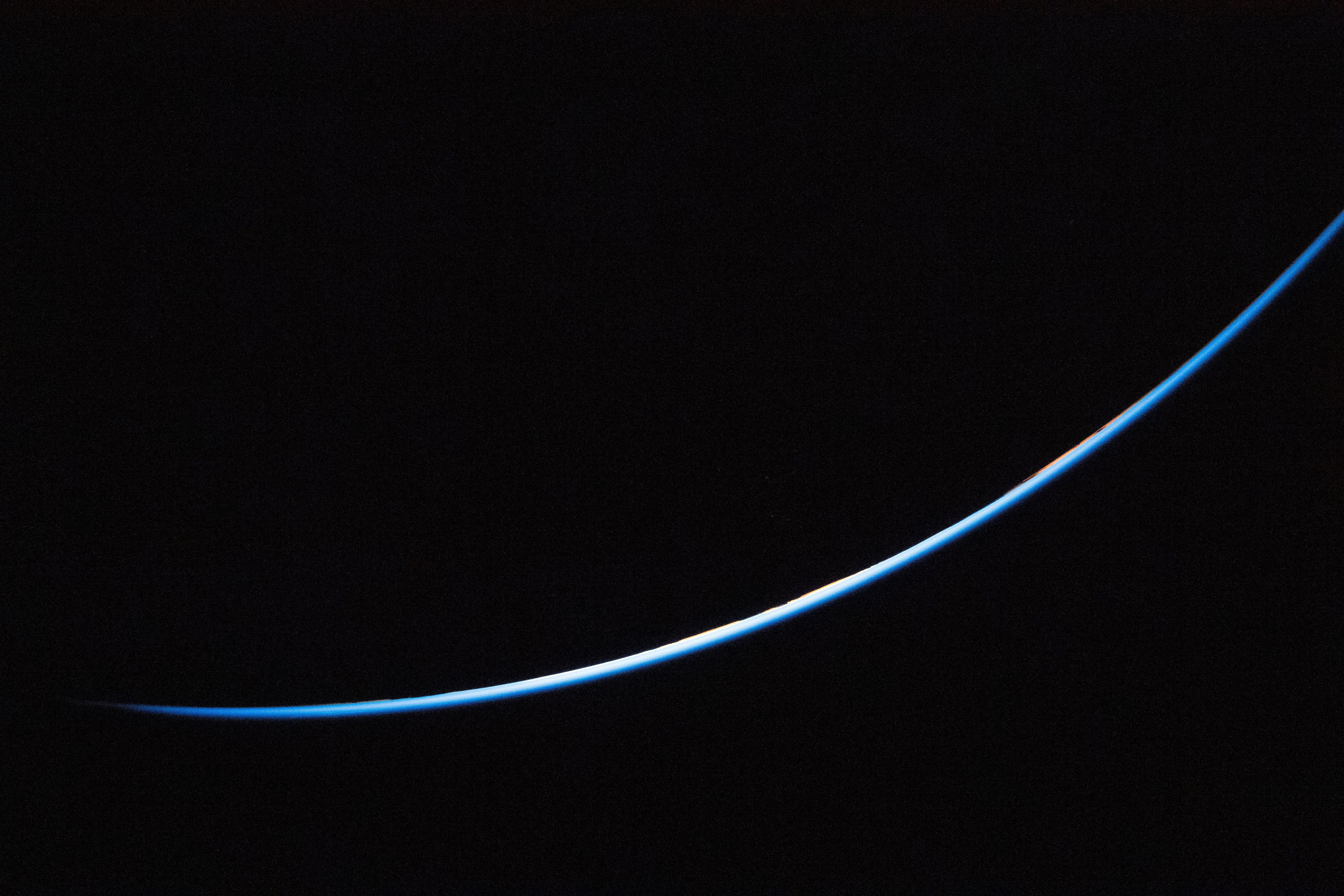
On April 3, 2026, the crew aboard NASA's Orion spacecraft captured a photograph that is already drawing comparisons to some of the most iconic images in the history of human spaceflight. The picture shows a slender, luminous arc — Earth's limb — cutting sharply across an otherwise unbroken field of black. There is no drama in the composition, only the stark, precise geometry of a planet seen from far away.
Artemis II was the first crewed flight of NASA's long-range lunar return program. The mission was not designed to land on the Moon; instead, it served as an end-to-end validation of the Orion capsule and its supporting systems under real deep-space conditions, with astronauts on board. By completing that shakedown flight successfully, the mission clears a critical technical threshold on the path toward Artemis III, which is expected to place crew members on the lunar surface.
NASA released the image on May 7, 2026, and it quickly drew attention well beyond the usual spaceflight community. Part of its power lies in what it communicates without words: the atmosphere protecting all life on Earth is, from even a modest cosmic distance, little more than a thin skin. Animated versions of the same footage have also circulated online, adding a sense of motion and reinforcing just how far the crew had traveled from home.
Webb turns its eye on Messier 77
At scales that dwarf anything achievable by human exploration, the James Webb Space Telescope — operated jointly by NASA, ESA, and the Canadian Space Agency — has released its latest Picture of the Month, centered on the galaxy Messier 77. Located roughly 45 million light-years away in the constellation Cetus, M77 is a barred spiral galaxy that has long been a reference object for researchers studying active galactic nuclei.
The new image was captured using Webb's Mid-Infrared Instrument, known as MIRI. By observing in mid-infrared wavelengths, MIRI cuts through obscuring dust to reveal the internal architecture of the galaxy's spiral arms with a level of clarity that ground-based or earlier space-based observatories could not match. The swirling dust lanes, their varying densities, and the bright concentration of energy at the galaxy's core are all rendered with fine angular resolution.
M77 is classified as a Seyfert galaxy, meaning its compact central region hosts a supermassive black hole currently pulling in surrounding material at a high rate. That accretion process drives intense radiation from a zone only a few parsecs across. Webb's infrared sensitivity allows astronomers to study both the galaxy's large-scale structure and those energetic central processes within a single observation, something that represents a genuine step forward in multi-scale astrophysics.
Different distances, shared purpose
Separated by an almost incomprehensible gap in scale — tens of thousands of kilometers for the Artemis II photograph, 45 million light-years for the Webb image — these two pictures nonetheless reflect the same underlying drive: to see farther and understand more. One looks back at Earth from near the Moon; the other looks outward into a universe measured in billions of years.
Taken together, they offer a snapshot of where international space exploration stands in spring 2026. NASA is advancing on two parallel tracks — human spaceflight within the inner solar system, and robotic astrophysical observation of the deep cosmos. Both efforts inform each other, technically and in terms of public engagement, and both depend on sustained institutional commitment to continue delivering results of this caliber.