Artemis II: Earth reduced to a sliver of light
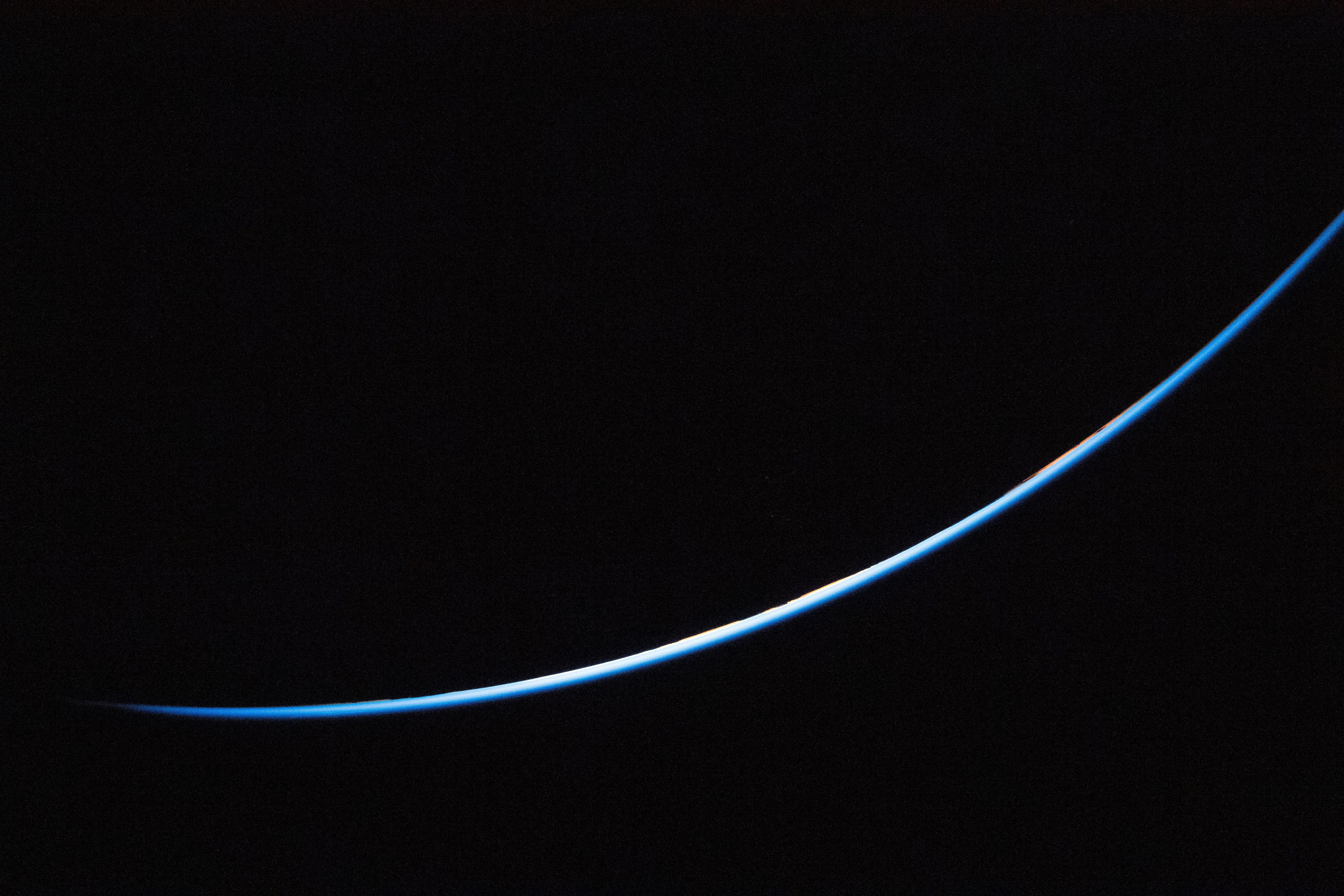
On April 3, 2026, the crew aboard NASA's Orion capsule during the Artemis II mission photographed something quietly profound: a narrow, luminous edge of Earth set against the absolute black of deep space. NASA released the image on May 7, drawing renewed attention to what the mission represents in the broader arc of human spaceflight.
Artemis II was the first crewed test flight of NASA's deep space architecture, designed to validate the Orion spacecraft and Space Launch System under real mission conditions before any astronauts attempt a lunar landing. No Moon landing was planned for this qualification flight, but simply sending a crew beyond low Earth orbit marked the farthest humans had traveled from home since the Apollo era.
An animated version of the orbital footage — highlighted by Ars Technica — underscores the effect even more than the still photograph alone. Watching Earth rotate slowly in the frame while the Orion capsule drifts further away gives a visceral sense of scale and solitude. The thin atmospheric glow visible at the planet's limb is a reminder of just how narrow the margin of habitability actually is.
Webb reveals the fiery heart of Messier 77
Far removed from any human timeline, the James Webb Space Telescope — a joint endeavor of NASA, ESA, and the Canadian Space Agency — released its latest Picture of the Month this week, focusing on Messier 77, a barred spiral galaxy roughly 45 million light-years distant in the constellation Cetus.
Webb's Mid-Infrared Instrument, known as MIRI, captured M77 in a way no previous observatory could manage. The result is a detailed rendering of the galaxy's sweeping spiral arms, threaded with lanes of cold interstellar dust, all converging on a core that blazes with unusual intensity. That brightness is no accident: M77 is a Seyfert galaxy, meaning its nucleus harbors an actively feeding supermassive black hole that radiates enormous quantities of energy across the electromagnetic spectrum.
Astronomers value M77 for precisely this combination — close enough to resolve fine structural detail, yet complex enough to test models of how active galactic nuclei shape the galaxies they inhabit. Webb's infrared sensitivity cuts through dust that would obscure shorter-wavelength observations, making MIRI an especially well-suited tool for this kind of study.
Parallel pursuits, one expanding frontier
Published within hours of each other, these two images capture the dual nature of contemporary space exploration. On one side, a crewed program — Artemis, led by NASA with a coalition of international partners — methodically rebuilding humanity's capacity to operate beyond Earth orbit and, eventually, on the lunar surface. On the other, a robotic observatory producing scientific results at a pace that has already reshaped several fields of astrophysics.
The Artemis schedule remains subject to revision, as it has been throughout the program's development. Webb, by contrast, is now in full scientific operation and showing no signs of slowing down. Together, the two endeavors suggest that space exploration in the 2020s is less a single race than a broad, multifaceted expansion — one image at a time.