Rethinking the lunar roadmap
The Moon's south polar region has become the undisputed focal point of 21st-century lunar ambitions. NASA's Artemis program is built around it, China's CNSA has already sent the Chang'e 6 mission to the lunar far south, and ISRO's Chandrayaan-3 successfully landed near the pole in 2023. The driving logic is straightforward: permanently shadowed craters in the polar regions are believed to harbor water ice, a resource that could be processed into propellant or drinking water for long-duration stays.
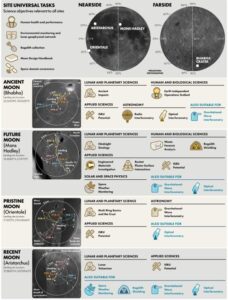
Yet a newly released report from the National Academies of Sciences, Engineering, and Medicine urges the scientific community — and policymakers — not to treat the south pole as the Moon's only worthy destination. The report identifies four distinct locations elsewhere on the lunar surface that could offer significant scientific returns if visited by human crews. The findings do not dismiss the south pole's value, but they make a clear case for a broader, more geologically diverse approach to exploration.
What makes these four sites stand out
While the full list of candidate sites has not been disclosed in its entirety, the expert committee evaluated locations based on several scientific criteria: access to ancient crustal material, exposure of rocks potentially originating from the lunar mantle, evidence of past volcanic activity, and proximity to terrain that has never been sampled — either by the Apollo astronauts or by Soviet-era robotic landers.
Each of these sites could serve as a window into a different chapter of the Moon's geological history. Ancient impact basins, for instance, may preserve material dating back more than four billion years, offering clues about the heavy bombardment period that shaped the rocky planets of the inner solar system. Volcanic regions, meanwhile, could clarify how and when the Moon's internal heat dissipated — a question with direct relevance to understanding planetary evolution more broadly.
The report also flags a practical concern: concentrating all infrastructure and human presence in a single polar zone creates systemic vulnerabilities. A multi-site strategy would distribute risk and maximize the scientific return per mission.
Implications for Artemis and the broader race to the Moon
The timing of this report is significant. NASA's Artemis program is navigating a period of budgetary uncertainty, and the date of the first crewed lunar landing remains unconfirmed. Meanwhile, China has publicly committed to landing astronauts on the Moon by around 2030, with polar regions also in its sights. The geopolitical dimensions of lunar exploration are intensifying, and scientific priorities risk being subordinated to strategic ones.
National Academies reports carry no binding authority, but they carry weight in congressional discussions and can shape how agencies justify their mission architectures. Scientists have increasingly warned that human spaceflight programs must remain anchored in research objectives — not merely serve as demonstrations of national capability.
Whether NASA, ESA, or their commercial partners such as SpaceX and Rocket Lab will be able to act on these recommendations within current budget frameworks remains an open question. What the report makes clear is that the Moon is far more varied — and scientifically richer — than any single destination can capture.