NGC 7771: a galaxy group in gravitational turmoil
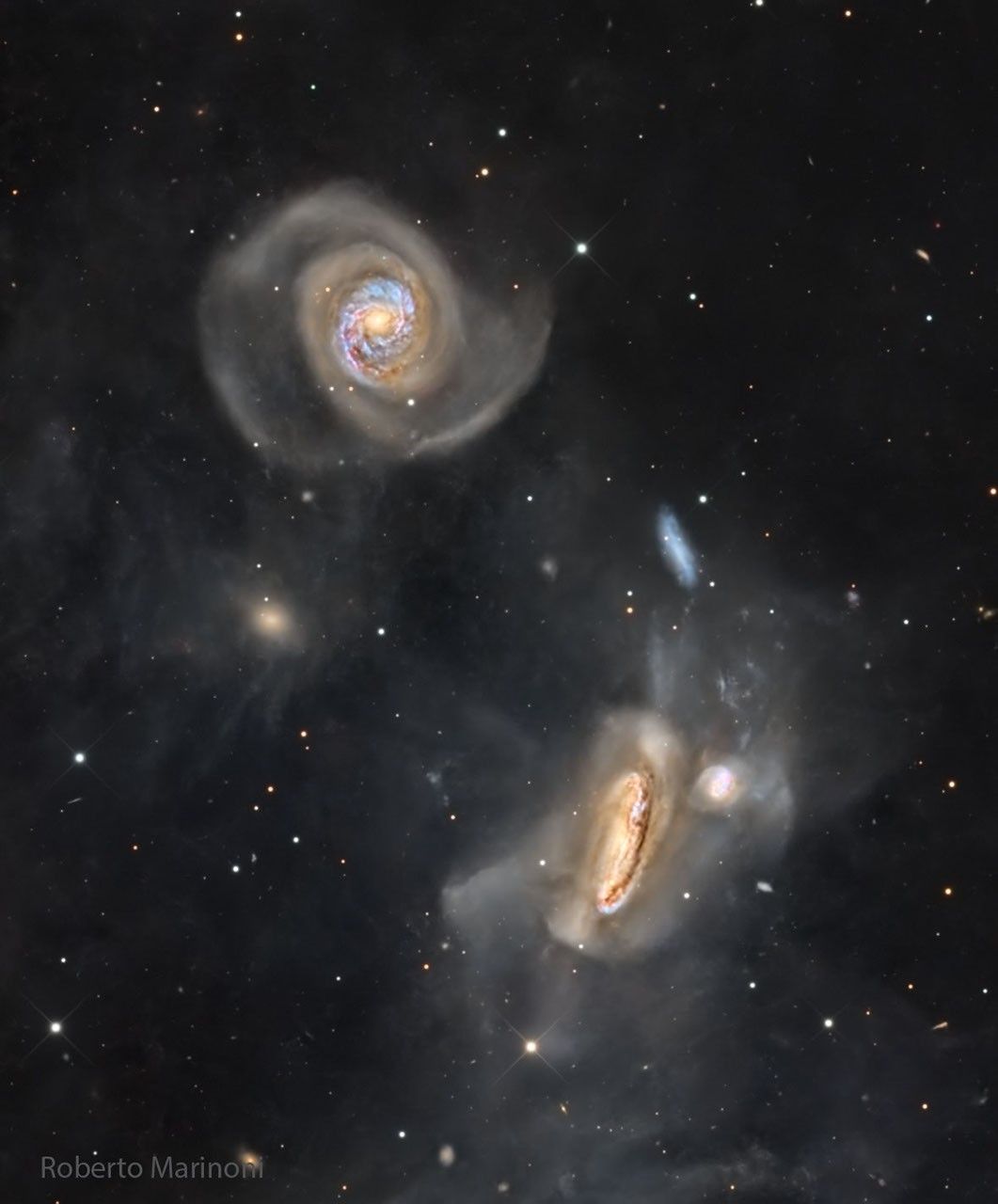
On November 24, 2026, NASA's Astronomy Picture of the Day (APOD) featured the NGC 7771 group, a collection of galaxies locked in a slow-motion gravitational struggle. The centrepiece, NGC 7771, is a barred spiral whose arms show clear signs of distortion — the hallmark signature of tidal forces at work across hundreds of thousands of light-years.
Galactic interactions of this kind rarely produce direct stellar collisions. Stars are simply too sparsely distributed for that. What does happen, however, is that vast clouds of interstellar gas get compressed as the galaxies draw closer, triggering bursts of accelerated star formation. Astronomers refer to these episodes as starburst activity, and groups like NGC 7771 are among the most productive laboratories for studying this process.
The image, selected and annotated by professional astronomers as part of APOD's editorial process, serves as a reminder that galaxies are far from static objects. They evolve, interact, and occasionally merge over billions of years, gradually reshaping the large-scale architecture of the universe itself.
Voyager: still sending signals from the edge of everything
A few days earlier, on November 20, NASA's daily astronomy showcase turned its attention to a very different subject: the Voyager programme. Pegged to a November 17 flyby anniversary, the image brought renewed attention to what remains one of the most audacious engineering achievements in the history of spaceflight.
Launched by NASA in 1977, Voyager 1 and Voyager 2 are the most distant human-made objects ever built. Voyager 1 crossed the heliopause — the outer boundary of the Sun's magnetic influence — and entered interstellar space, now travelling more than 23 billion kilometres from the Sun. Voyager 2 followed on a separate trajectory. Both spacecraft continue to return scientific data via NASA's Deep Space Network, though signals now take over twenty hours to complete the journey to Earth.
That the two probes remain operational nearly five decades after launch, still communicating across interstellar distances, is a testament to the durability of 1970s engineering and to the sustained commitment of the teams that keep the mission alive.
APOD at thirty: the quiet power of a daily image
Running continuously since 1995, APOD has built a global audience by offering something deceptively simple: one image, one explanation, every day. The annotations are written by working astronomers and are aimed at curious non-specialists — precise enough to be informative, accessible enough to draw in readers with no background in astrophysics.
The two November 2026 selections capture something of the programme's range. One looks outward at a universe in perpetual gravitational flux; the other looks back at a machine humanity launched into the void before most of its current audience was born. Both raise questions that remain genuinely open in contemporary research.
As observatories like the James Webb Space Telescope continue to push the boundaries of what can be seen, there is no shortage of material. The deep sky, it turns out, rewards patient attention — and APOD has been making that case, one image at a time, for thirty years.