Juno keeps peeling back Jupiter's layers
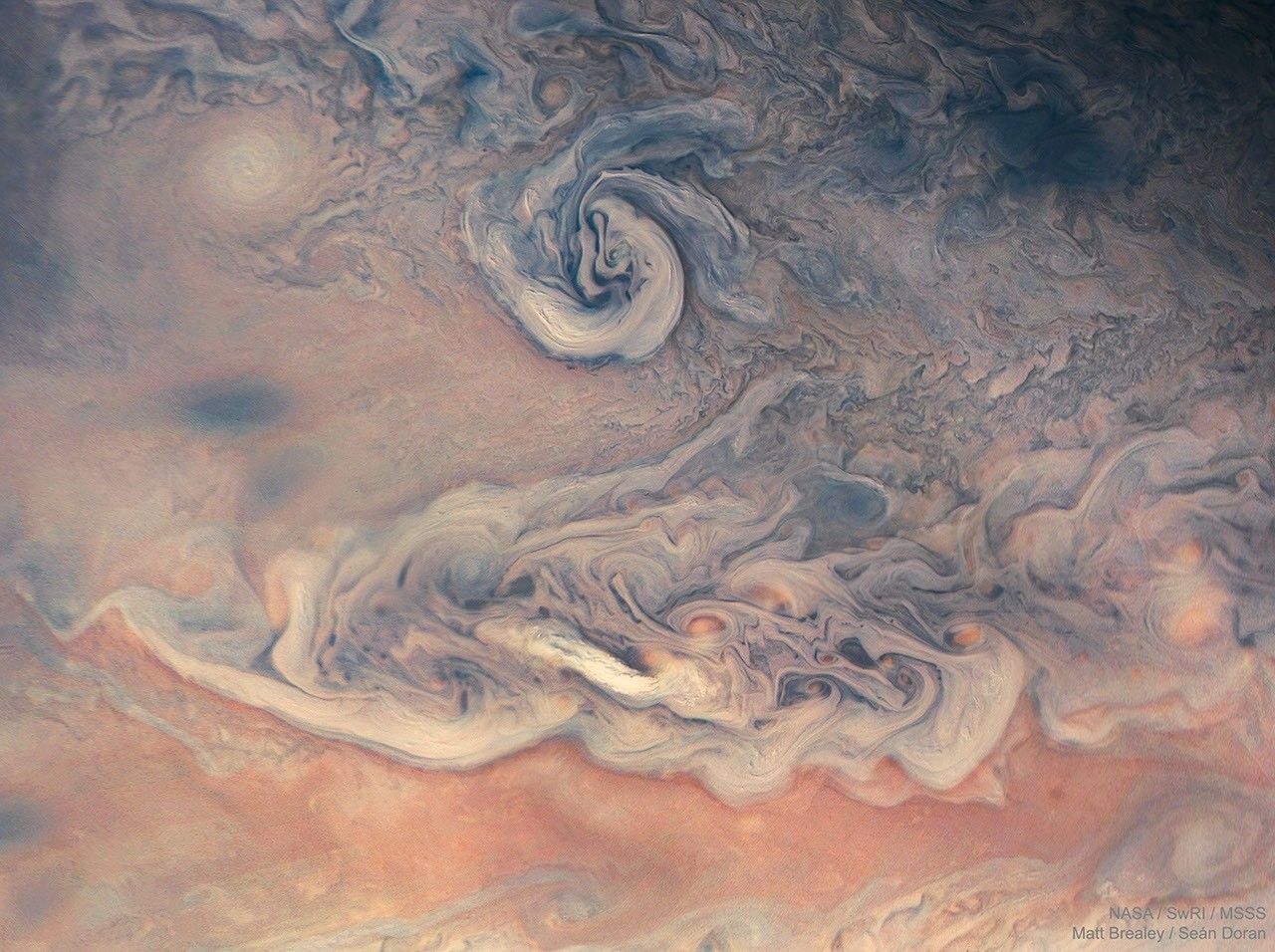
Nearly a decade into its mission, NASA's Juno spacecraft continues to transform how scientists think about Jupiter. The latest imagery highlighted by the Astronomy Picture of the Day showcases a vivid tapestry of interlocking bands, oval storms, and turbulent eddies stretching across the gas giant's upper atmosphere. What looks like abstract art from a distance is, in reality, a record of some of the most energetic weather systems in the solar system — jet streams moving at several hundred kilometers per hour, flanked by anticyclones that have persisted for years.
Juno achieves these close-up views by skimming Jupiter's cloud tops at altitudes of just a few thousand kilometers during each perijove pass. The spacecraft's suite of instruments — including a microwave radiometer capable of probing beneath the visible cloud deck — has revealed that many of these atmospheric features extend far deeper than theoretical models predicted. Those findings, produced in collaboration with researchers at the Jet Propulsion Laboratory and several European institutions, have required a substantial rethink of Jupiter's internal dynamics. The mission, extended well beyond its original 2021 end date, continues to generate peer-reviewed science with each new orbit.
Voyager's flyby, remembered across the decades
Days before the Juno image made the APOD front page, the program paid tribute to a milestone tied to Voyager: the anniversary of a flyby on November 17 that became one of the defining moments of robotic space exploration. The twin Voyager probes, launched in 1977 by NASA, took advantage of a rare planetary alignment — occurring roughly once every 175 years — to conduct the first close reconnaissance of the outer solar system, visiting Jupiter, Saturn, and in Voyager 2's case, Uranus and Neptune as well.
Both spacecraft have long since crossed the heliopause and entered interstellar space. Voyager 1, currently more than 23 billion kilometers from the Sun, remains the most distant human-made object ever built. That it still transmits measurable signals back to Earth via NASA's Deep Space Network is a testament to the engineering margins built into hardware designed in the early 1970s. Voyager 2, traveling on a different trajectory, continues to return data on the properties of the interstellar medium.
Different eras, the same drive to understand
Placing Juno and Voyager side by side reveals something important about how planetary science actually works. Voyager gave humanity its first detailed look at the outer planets in a single grand tour; Juno has spent years circling just one of them, drilling deeper into questions that Voyager's brief flyby could only raise. The two approaches are not competing philosophies but complementary ones — the sprint and the marathon of scientific inquiry.
As commercial launch providers dominate headlines and crewed missions to the Moon and Mars absorb much of the public's attention, robotic science missions like these quietly accumulate the data that will define planetary science for generations. The swirls visible in Juno's latest images are not just visually arresting — they are open scientific questions, encoded in cloud patterns, waiting for researchers to decode them.