A familiar object seen in unprecedented detail
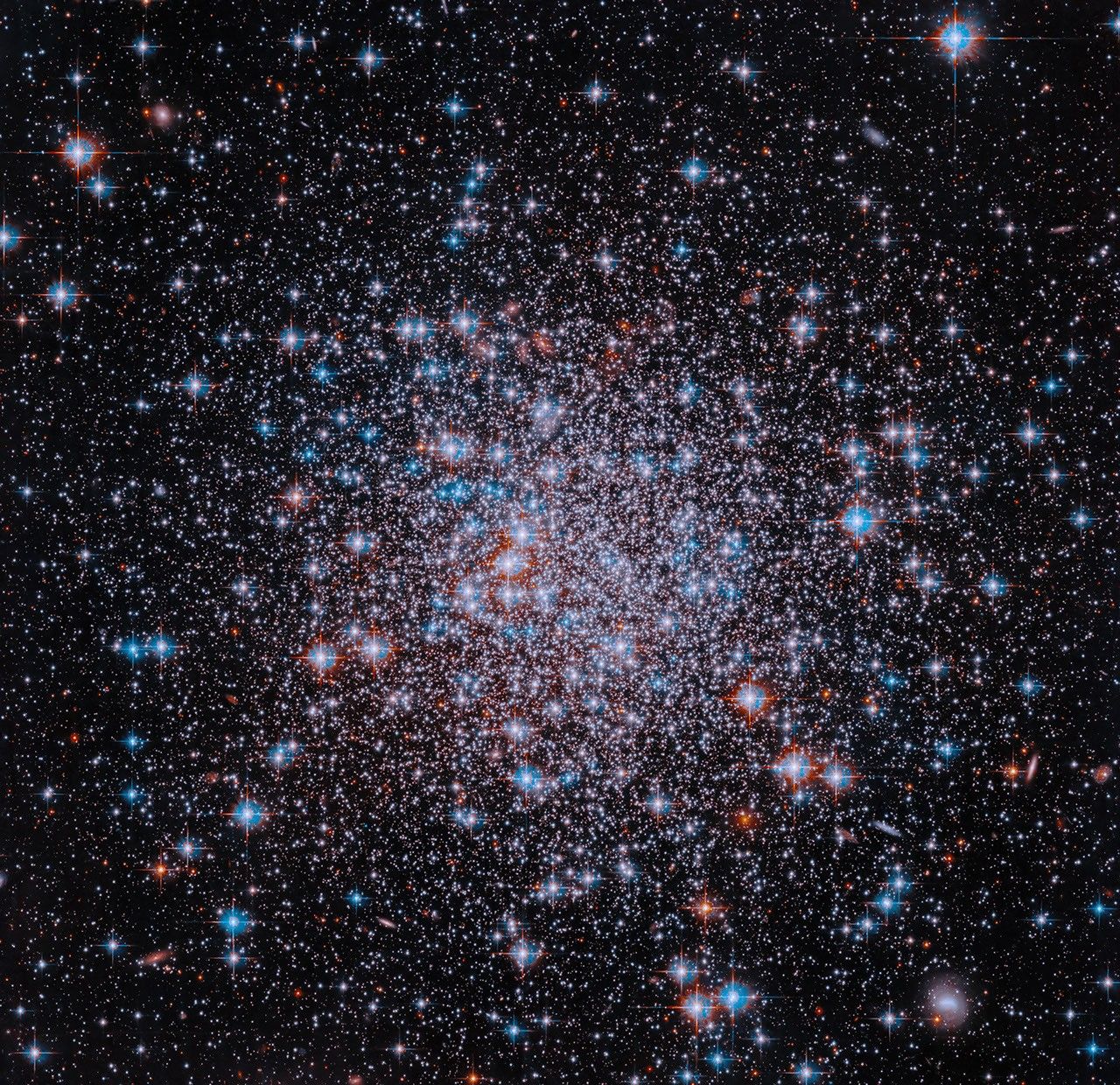
Globular cluster Messier 3 has been studied by astronomers for centuries — Charles Messier himself logged it in the late 1700s — but a fresh series of images from NASA's Hubble Space Telescope, released in early July 2026, brings this ancient stellar city into sharper focus than ever before. Sitting roughly 34,000 light-years from Earth, M3 packs more than 500,000 stars into a gravitationally bound sphere that formed when the universe was still young. Hubble's Wide Field Camera 3 (WFC3) resolves individual stars across the cluster's crowded core, a feat that remains beyond the reach of ground-based observatories.
What immediately draws the eye in these new frames is the striking range of colors. Stars rendered in blue, white, and deep red scatter across a backdrop of ionized crimson gas, producing an image that NASA teams described as reminiscent of a sparkler being waved through a dark summer night. The timing of the release, coinciding with the Fourth of July, gave the imagery an added resonance — though the science behind those colors is what genuinely matters.
Reading stellar evolution through color
In astronomy, color is a direct proxy for temperature, and temperature tracks where a star sits in its life cycle. The blue and white stars visible in Hubble's M3 image are among the hottest objects in the cluster. Many belong to what astronomers call the horizontal branch — stars that have already burned through the hydrogen in their cores and are now fusing helium. The cooler red stars, by contrast, are typically red giants: older, expanded stars in a late evolutionary phase, radiating energy across a much larger surface area.
Having all these evolutionary stages present within a single object is precisely what makes globular clusters scientifically valuable. M3 is estimated to be around 11.4 billion years old, placing it among the oldest structures in the Milky Way. It also hosts one of the richest known populations of RR Lyrae variable stars — more than 200 have been catalogued — which are used as reliable distance markers across the galaxy. Hubble's sharp optical imaging helps astronomers measure the brightness and pulsation periods of these variables with high precision, feeding directly into models of stellar aging and galactic structure.
Why Hubble still matters alongside Webb
NASA's James Webb Space Telescope has dominated headlines since its science operations began, and for good reason: its infrared capabilities have pushed the observable frontier of the universe back to within a few hundred million years of the Big Bang. But Webb does not replace Hubble. The two telescopes occupy different but complementary niches. Hubble's strength in optical and ultraviolet wavelengths makes it uniquely suited for studies that require measuring surface temperatures, chemical compositions visible in the UV, and fine structural detail in nearby objects — all areas where Webb's infrared detectors offer limited insight.
Research teams routinely combine data from both observatories to build fuller pictures of whatever they're studying. For a target like Messier 3, Hubble's visible-light data captures stellar colors and surface properties that are essential for classifying the cluster's populations by age and metallicity. That kind of multi-instrument approach has become standard practice at NASA and partner institutions worldwide.
More than three decades after its 1990 launch, Hubble continues to produce scientifically significant observations. The M3 images serve as a timely reminder that longevity in space science is not about replacing old tools with new ones, but about knowing how to use each instrument where it excels most.