Where has all the oxygen gone?
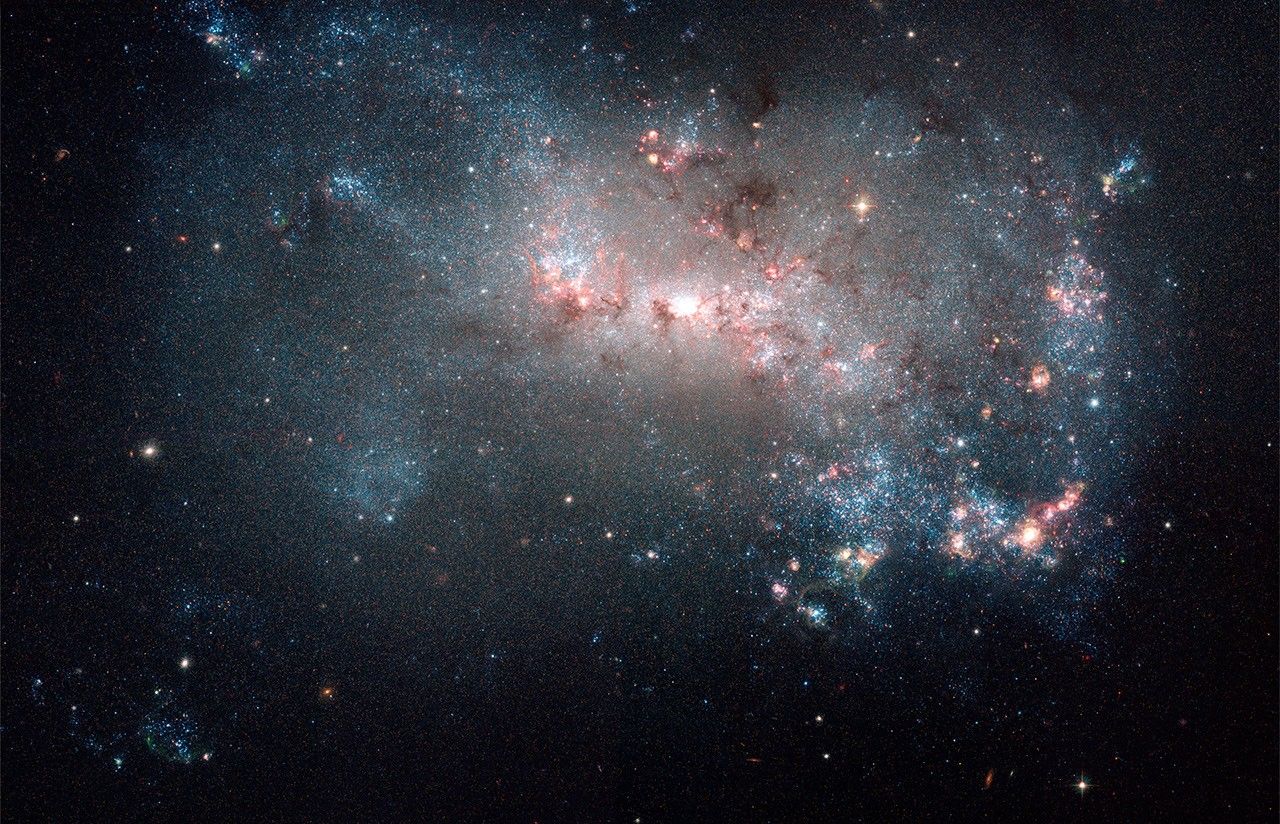
A team of researchers working with data from NASA's Hubble Space Telescope has identified a striking chemical discrepancy in 37 nearby dwarf galaxies: a substantial portion of the oxygen these small stellar systems should contain appears to be missing. The findings, released in early November 2026, raise questions that current astrophysical models struggle to fully answer.
One of the galaxies at the center of the study is NGC 4449, a dwarf irregular system. Like others in the sample, it produces oxygen through stellar nucleosynthesis — the same processes that forge heavy elements inside stars — yet the detected quantities fall well short of theoretical predictions. Researchers have proposed several explanations: powerful stellar winds, supernova-driven outflows carrying enriched gas into the intergalactic medium, or oxygen distributed too diffusely to register in current observations. No single explanation has emerged as definitive.
The study underscores Hubble's continued relevance. More than 36 years after its launch, the telescope remains one of the few instruments capable of resolving the low-surface-brightness environments where dwarf galaxies reside, and its ultraviolet sensitivity has no direct operational equivalent today.
Reboost or risk an uncontrolled fall?
While the science continues to flow, Hubble's long-term orbital survival has become an active policy question. NASA Administrator Jared Isaacman addressed the issue publicly in early November 2026, making the case that allowing the telescope to reenter Earth's atmosphere in an uncontrolled manner is not an acceptable outcome. At its current altitude, Hubble is slowly losing orbital energy to atmospheric drag, and without intervention, an unguided reentry becomes increasingly likely over the coming years.
Isaacman has advocated for a dedicated reboost mission — a spacecraft operation that would raise Hubble's orbit and extend its functional lifespan by a meaningful margin. The concept of using a commercial vehicle for such an operation has been discussed in preliminary studies, with SpaceX having been mentioned in that context, though no formal contract or program has been announced as of this writing.
Key uncertainties remain: the cost of a reboost mission, the remaining operational life of Hubble's onboard instruments, and the institutional willingness to commit resources to a telescope that has no clear successor for its ultraviolet capabilities. NASA has not released a formal timeline for a decision.
A legacy too valuable to leave to chance
Hubble was launched in 1990 and kept alive through five servicing missions carried out by Space Shuttle crews. Over the decades, it has delivered observations that reshaped cosmology — from pinning down the universe's expansion rate to confirming the near-universal presence of supermassive black holes at galactic centers, and contributing to early exoplanet atmospheric characterization.
The James Webb Space Telescope, a joint mission by NASA, ESA, and the Canadian Space Agency, has taken over many of Hubble's infrared science objectives since its commissioning. But Webb does not replicate Hubble's ultraviolet coverage, leaving a gap that no other currently operational facility fills. For Isaacman, that scientific continuity, combined with the safety concerns around an uncontrolled reentry, makes the case for a reboost mission both scientifically and practically compelling. Whether that argument translates into a funded program remains to be seen.