Artemis II frames our world from deep space
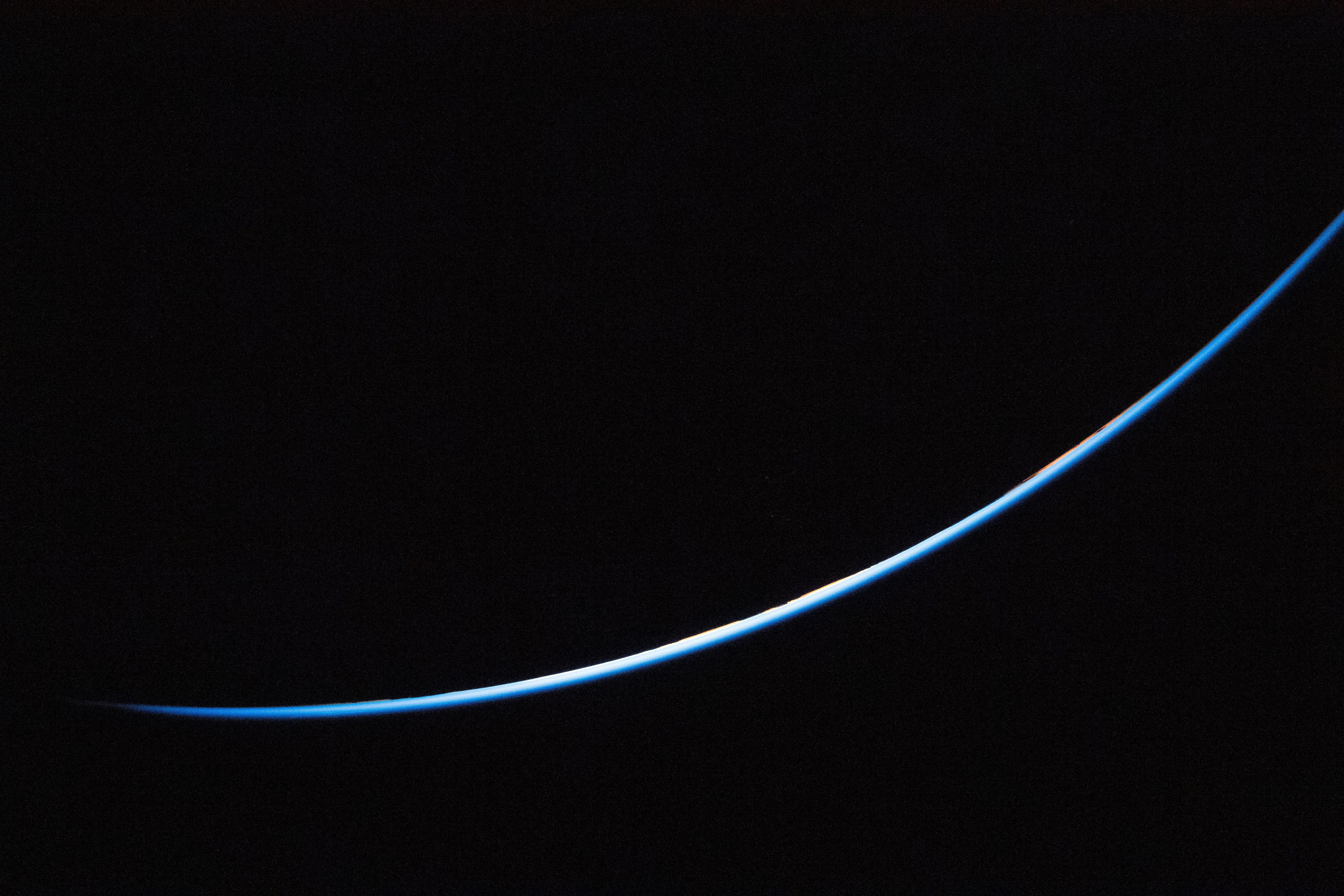
On April 3, 2026, the crew aboard NASA's Orion spacecraft — traveling on the Artemis II mission — photographed Earth reduced to a thin luminous arc against an unbroken black void. No coastline, no recognizable landmass: just a curved sliver of light that quietly underscores how alone our planet sits in the cosmos.
Artemis II marks the first time since the Apollo era that human beings have traveled beyond low Earth orbit aboard a crewed vehicle. The mission is not designed to land on the Moon — that milestone is reserved for a future flight — but rather to put the full Orion capsule and Space Launch System stack through their paces with astronauts on board. The objectives include validating deep-space communication links, life support systems, and the navigation procedures that will be essential when crews eventually attempt a lunar surface landing.
NASA released the photograph in early May 2026, and it quickly drew comparisons to earlier iconic views of Earth from space — the Earthrise image captured by Apollo 8 in 1968, or the Pale Blue Dot framed by Voyager 1 in 1990. What sets this one apart is its context: it belongs to a new chapter of human exploration, one that is methodical and incremental but unmistakably pointed toward the Moon and, eventually, deeper destinations.
Webb peers through the dust of Messier 77
At a distance that makes the Moon seem like a next-door neighbor, the James Webb Space Telescope — operated jointly by NASA, ESA, and the Canadian Space Agency (CSA) — has produced a new image of Messier 77, a barred spiral galaxy located roughly 45 million light-years away in the constellation Cetus.
M77, also catalogued as NGC 1068, is a well-studied object in astrophysics, prized for its relatively close proximity and the intensity of activity at its core. It hosts a Seyfert-type active galactic nucleus: a supermassive black hole actively pulling in surrounding material, wrapped in thick layers of gas and dust that block most forms of visible light. Webb's Mid-Infrared Instrument, known as MIRI, cuts through those obscuring layers to reveal the galaxy's architecture with a clarity not previously achievable — the sweeping spiral arms, the warm dust filaments threading through the disc, and a brilliantly compact nucleus at the center.
ESA published the image as its Picture of the Month on May 7, 2026. Beyond its visual impact, the observation carries real scientific weight: the infrared spectra gathered by MIRI will help researchers characterize the dust composition around the nucleus and shed light on the feeding mechanisms of active galactic nuclei — one of the more persistent open questions in extragalactic astronomy.
Different scales, the same dynamic
The gap between these two images — one taken a few hundred thousand kilometers from home, the other mapping a galaxy 45 million light-years away — is almost impossible to fully internalize. Yet both share a structural parallel: a point or line of light holding its own against surrounding darkness, whether it is sunlight grazing the edge of Earth's atmosphere or infrared radiation from an actively accreting black hole punching through interstellar dust.
Taken together, the two releases illustrate the breadth of what space agencies are doing in 2026: human missions resuming their reach toward the Moon, and observatory science pushing ever further into the structure of the universe. As the Artemis program advances toward its next crewed milestones and Webb continues to build its archive of deep-field observations, images like these serve as periodic reminders of how much ground — and how much sky — is still left to cover.