The substance that holds the cosmos together
Dark matter remains one of the most stubborn open questions in modern astrophysics. It emits no light, reflects none, and interacts with ordinary matter only through gravity — making it essentially invisible to every telescope and detector currently in operation. Yet the evidence for its existence is overwhelming. Without it, the rotational curves of galaxies make no physical sense, and the vast web of cosmic structure we observe today could never have formed from the near-uniform conditions of the early universe.
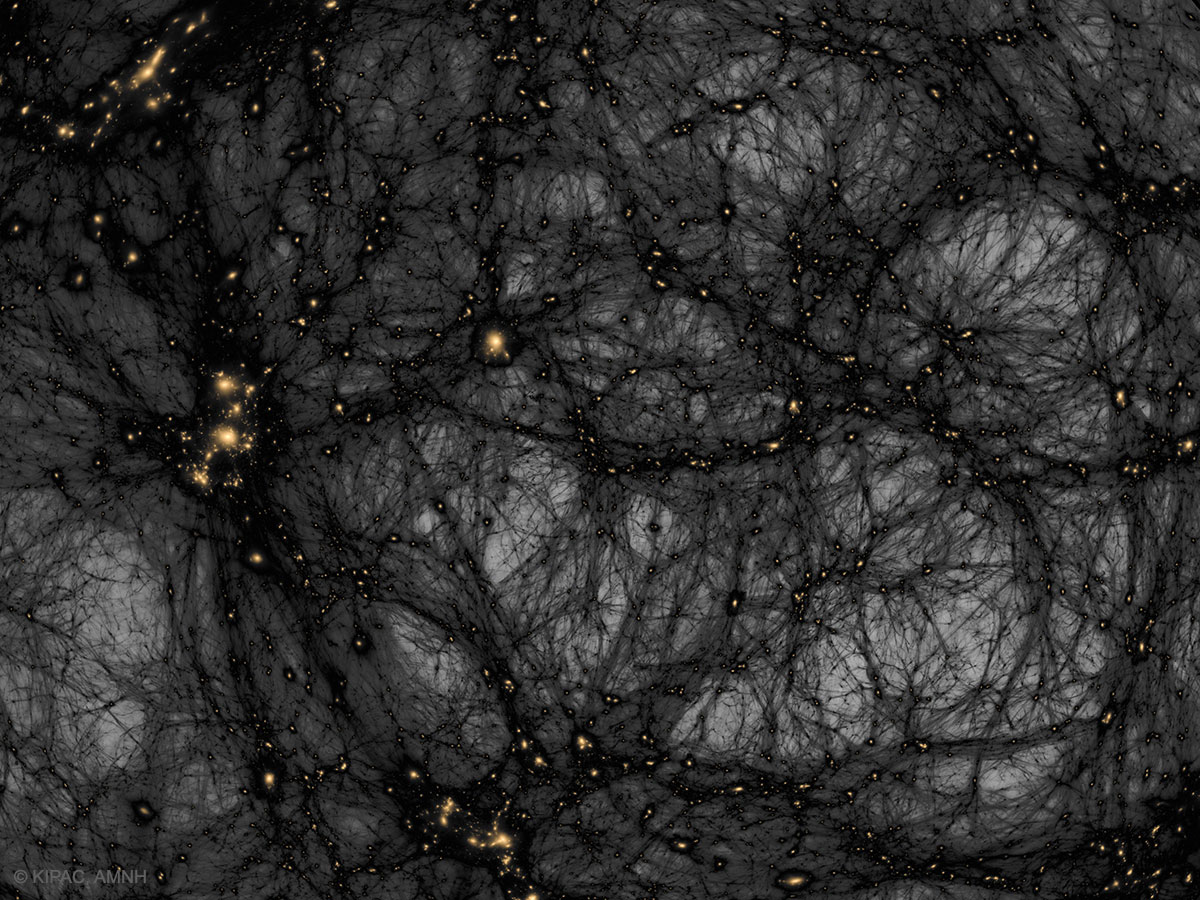
That paradox was brought back into focus late in October 2026, when NASA's Astronomy Picture of the Day featured an image drawn from a large-scale numerical simulation of dark matter distribution across cosmic scales. The visual — a dense lattice of filaments, nodes, and voids often described as the cosmic web — offers an arresting reminder of how much of the universe remains beyond direct observation.
Building universes in silicon
Cosmological simulations are far more than artistic renderings. They are built on rigorous physical models that incorporate gravitational dynamics, hydrodynamics, and initial conditions derived from observations of the cosmic microwave background. Projects such as IllustrisTNG, developed through an international research collaboration, generate synthetic universes whose statistical properties can be directly compared against real-sky surveys.
The European Space Agency's Euclid mission, which has been gathering data since its 2023 launch, plays a central role in this process. By mapping the geometry of the universe and the large-scale distribution of matter with high precision, Euclid provides the observational benchmarks against which simulations are tested. The goal is to identify the set of cosmological parameters — dark matter density, the cosmological constant, the rate of expansion — that best reproduce what we actually observe.
Where the models still fall short
Despite their sophistication, current simulations are not without problems. The standard cosmological model reproduces large-scale structure with considerable accuracy, but struggles at smaller scales. One well-documented discrepancy, known as the missing satellites problem, concerns the predicted number of dwarf satellite galaxies around major spiral galaxies: simulations consistently produce far more of them than astronomers find in observations. Whether this reflects a flaw in the dark matter model or gaps in our understanding of galaxy formation remains unresolved.
Researchers are counting on the next generation of both simulations and observational missions to narrow that gap. NASA's upcoming Nancy Grace Roman Space Telescope, combined with continued data from Euclid, is expected to provide constraints precise enough to distinguish between competing dark matter candidates — whether weakly interacting massive particles, axions, or something else entirely.
For now, numerical simulation remains one of the few tools capable of bridging the gap between theory and a universe that stubbornly refuses to reveal its most fundamental ingredient directly.