Testing inside a simulated Mars
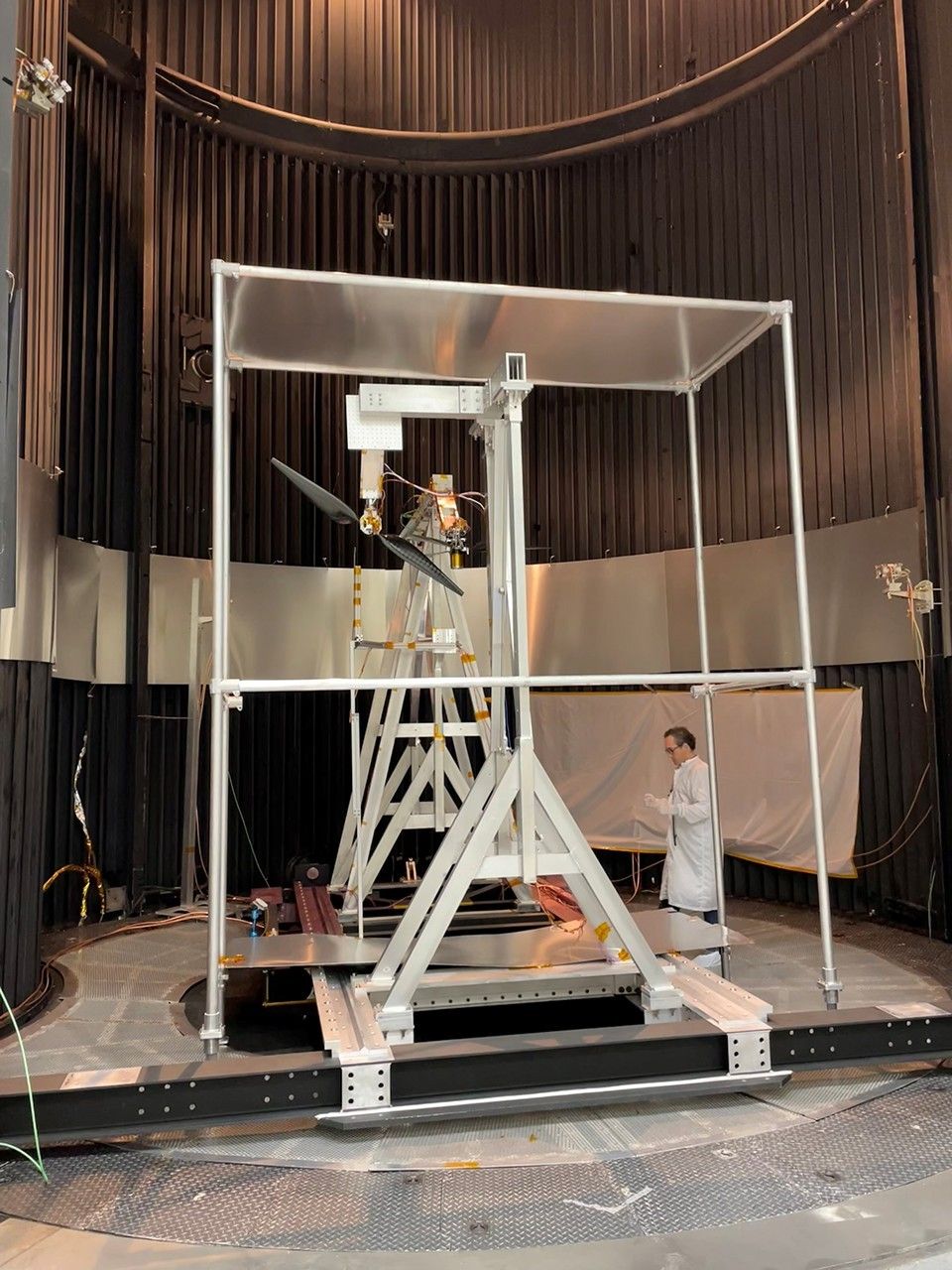
Reproducing the conditions of another planet's atmosphere inside a California laboratory is no small feat. Mars has an atmospheric density roughly one hundred times lower than Earth's, which changes everything from aerodynamic behavior to the speed of sound itself. To overcome that challenge, engineers at NASA's Jet Propulsion Laboratory in Southern California used the facility's 25-Foot Space Simulator — a large cylindrical chamber capable of replicating Martian pressure and atmospheric composition — to run a series of rotor tests in March 2025.
Engineer Fernando Mier-Hicks was among those who inspected the dedicated test stand and monitored the trials. The goal was straightforward but technically demanding: spin next-generation rotor blades to speeds far exceeding anything achieved by Ingenuity, the first rotorcraft to fly on another world.
Mach 1 reached, no structural damage
The test data tell a clear story. The blade tips — the fastest-moving part of any spinning rotor, and the section most exposed to aerodynamic stress — exceeded Mach 1 under simulated Martian conditions. Critically, the blades came through the tests without any structural failure.
On Mars, the speed of sound is approximately 240 meters per second, compared to 343 m/s at sea level on Earth. Even so, pushing composite rotor blades through the transonic regime is a significant mechanical challenge: shock waves, intense vibration, and compressibility effects can all compromise material integrity. The fact that the blades held together is a meaningful engineering validation.
NASA has not yet specified which future mission these rotors are being developed for. It is reasonable to assume — though not officially confirmed — that this work builds on the legacy of Ingenuity and is intended to support more capable rotorcraft for upcoming Mars exploration campaigns.
Raising the ceiling for Mars aerial exploration
Ingenuity reshaped expectations for what robotic exploration on Mars could look like. Originally designed for five demonstration flights, the small helicopter completed more than seventy sorties before operations ended in early 2024. That track record made a compelling case for investing in more advanced rotorcraft.
Blades rated for supersonic tip speeds would allow engineers to design heavier helicopters carrying more science instruments, or vehicles capable of covering greater distances on a single flight. Both attributes matter enormously on a planet where mission planners must work within tight mass budgets and where terrain can shift from navigable plains to impassable cliffs within a short distance.
NASA has not released a timeline for integrating these next-generation blades into a flight-ready vehicle. Further test cycles and long-duration material assessments will almost certainly be required before any rotorcraft carrying this hardware could be manifested on a Mars-bound spacecraft. For now, the March 2025 results represent a key technical checkpoint on that road.