Soyuz MS-29 carries a new crew to the orbiting laboratory
Soyuz MS-29 was scheduled to lift off from the Baikonur Cosmodrome in Kazakhstan on Tuesday, July 14, 2026, carrying a new crew to the International Space Station. The launch, conducted under Roscosmos authority, continues the uninterrupted chain of human presence aboard the orbital outpost that Russia and the United States have jointly maintained for well over two decades.
The Soyuz spacecraft has long served as the backbone of ISS crew rotations. Robust and repeatedly proven, the Russian capsule typically carries a mixed crew of Roscosmos cosmonauts and NASA or ESA astronauts through a carefully choreographed rendezvous profile in low Earth orbit. The MS-29 mission follows that well-established template, with procedures refined through decades of operational experience.
Despite the geopolitical fractures that have strained relations between Russia and Western nations since 2022, ISS cooperation has continued without interruption at the technical level. The station remains one of very few venues where the two legacy space powers still share day-to-day operational responsibilities.
SpaceX pushes Starship toward its thirteenth test flight
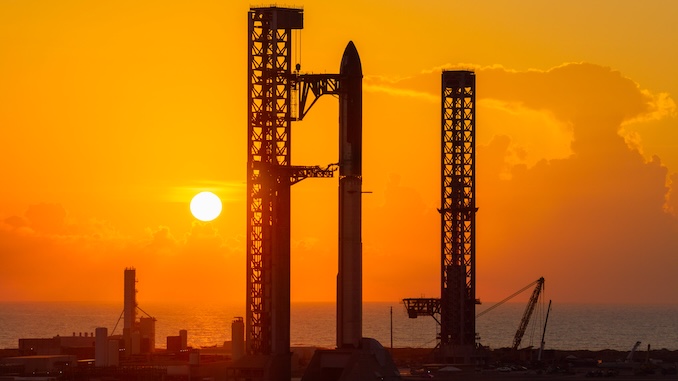
The same week, SpaceX was gearing up for the thirteenth integrated flight test of its Starship system from Starbase in South Texas. The program, aiming to qualify a fully reusable launch architecture capable of hauling heavy payloads to low Earth orbit, the Moon, and eventually Mars, has advanced through a series of increasingly ambitious demonstrations since its first attempts in 2023.
Each Starship flight stacks specific engineering objectives: validating the Raptor engine cluster under real flight loads, testing the mechanical catch system that retrieves the Super Heavy booster at the launch tower, and refining the heat shield's behavior during atmospheric reentry. The precise technical targets for this thirteenth attempt had not been officially confirmed at the time of writing.
The pace of Starship testing carries real urgency. SpaceX has commitments that hinge on the system's maturity, most notably a NASA contract to provide the Human Landing System for the Artemis lunar program. Demonstrating reliable, high-cadence operations is as important as any single flight milestone.
Two approaches to spaceflight, one remarkable week
Taken together, these two launches offer a sharp snapshot of how different spaceflight can look in 2026. Roscosmos operates a mature, methodical system built around decades of incremental refinement. SpaceX is running an accelerated development cycle that accepts iterative risk in exchange for rapid progress — a philosophy that sits at the opposite end of the institutional spectrum.
Seven launches in total were on the global manifest for the week of July 13, 2026, reflecting the increasingly dense cadence of orbital activity driven by a mix of government agencies and commercial operators. The frequency of access to space has never been higher, but the technical, diplomatic, and commercial stakes shaping that access have grown proportionally more intricate.