A two-telescope approach to a long-standing question
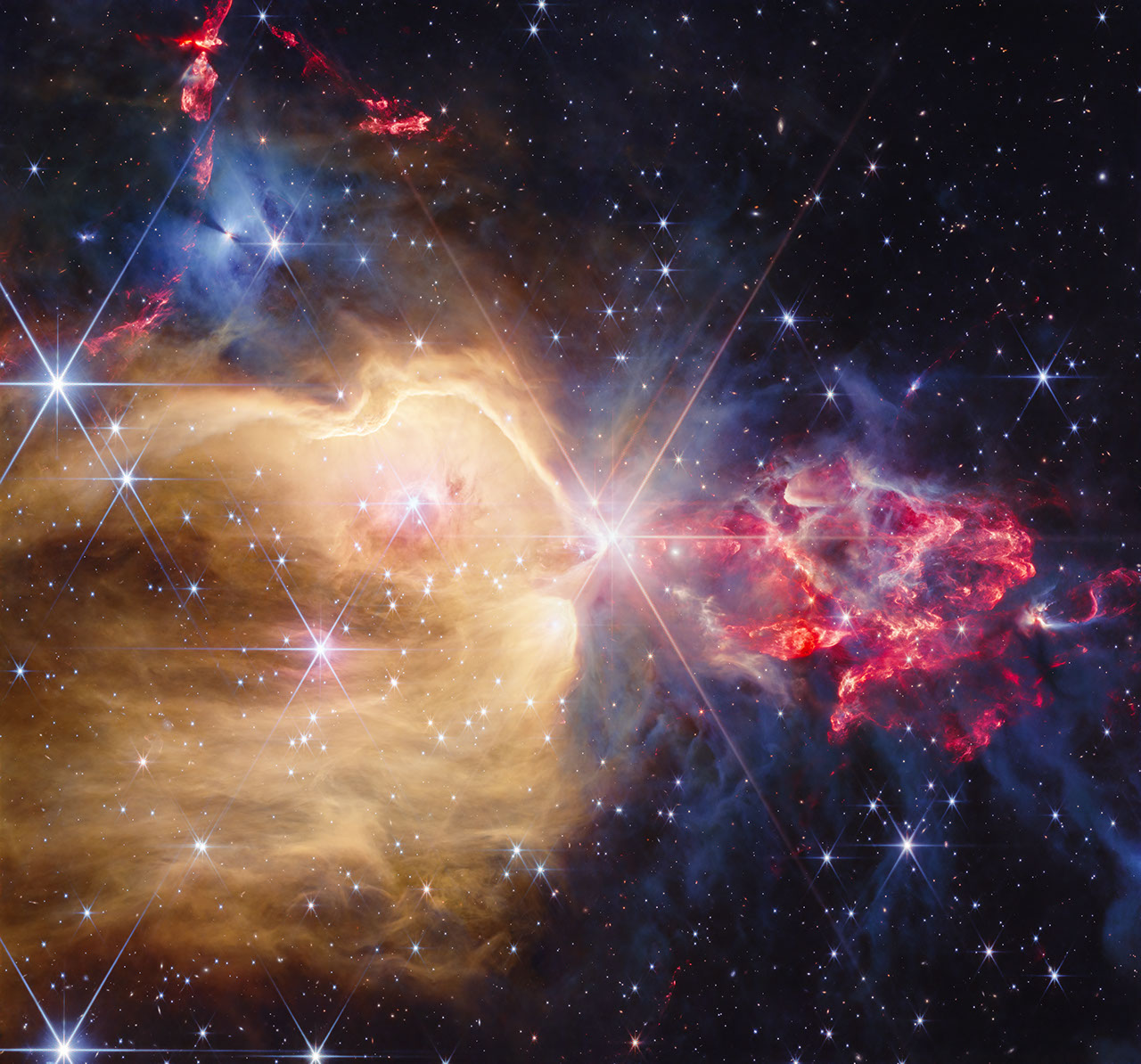
Star formation sits at the heart of galactic evolution, yet many of its details have remained stubbornly out of reach. An international team of astronomers has now turned two of the most powerful space observatories ever built — the NASA/ESA/CSA James Webb Space Telescope and the NASA/ESA Hubble Space Telescope — toward thousands of young star clusters embedded in four galaxies relatively close to our own. The goal was to trace the full arc of cluster development, from the earliest dust-shrouded stages through to the point when a cluster finally bursts free into the open interstellar medium.
The findings, released in early May 2026, deliver a clear and quantifiable answer to a question that has occupied astronomers for years: a cluster's mass is the primary factor governing how quickly it escapes from the gas cloud that gave rise to it.
Mass determines the pace of emergence
The mechanism is rooted in stellar physics. Massive clusters contain a higher proportion of heavy, luminous stars that generate intense radiation fields and powerful stellar winds. Together, these forces exert enough pressure to sweep surrounding gas and dust away from the cluster in a relatively short time. Lighter clusters, lacking that energetic firepower, remain embedded in their birth clouds for considerably longer before the same dispersal occurs.
Once a massive cluster has cleared its surroundings, it becomes a prolific source of ultraviolet radiation that floods broad regions of its host galaxy. This matters well beyond the immediate neighbourhood of the cluster itself: ultraviolet light can erode the protoplanetary disks — the rotating reservoirs of gas and dust where planets assemble — orbiting young stars nearby. Understanding which environments are bathed in this radiation, and for how long, directly informs models of where planetary systems are likely to form and survive.
NGC 3137 — a nearby spiral as a living laboratory
Complementing this research, Hubble has also produced a detailed portrait of the spiral galaxy NGC 3137, situated roughly 53 million light-years from Earth in the constellation Antlia. The galaxy's arms are studded with star clusters that appear as distinct knots of light against the broader stellar disk, making it an unusually clean target for studying the birth-to-death cycle of stellar populations. Its relative proximity allows astronomers to resolve individual clusters that would be blurred together in more distant systems.
The image underscores how effectively Hubble continues to operate alongside Webb rather than being superseded by it. While Webb's infrared sensitivity lets it peer through dust veils to catch clusters at their youngest stages, Hubble's sharp optical and ultraviolet vision maps the structural features of galaxies with a precision that remains difficult to match.
Building a fuller picture of galactic star formation
Taken together, these results demonstrate the value of coordinated multi-instrument campaigns in modern astronomy. By combining Webb and Hubble observations of clusters spanning a range of ages and masses, researchers now have a more complete evolutionary sequence than any single observatory could provide. The data will feed directly into simulations of galactic chemical enrichment and structure formation, and will sharpen predictions about the environments most conducive to planet — and potentially life — formation. Whether this rapid-emergence mechanism for massive clusters holds across more distant, earlier-epoch galaxies remains an open question that future observing campaigns with both telescopes are expected to address.