A large-scale census of stellar nurseries
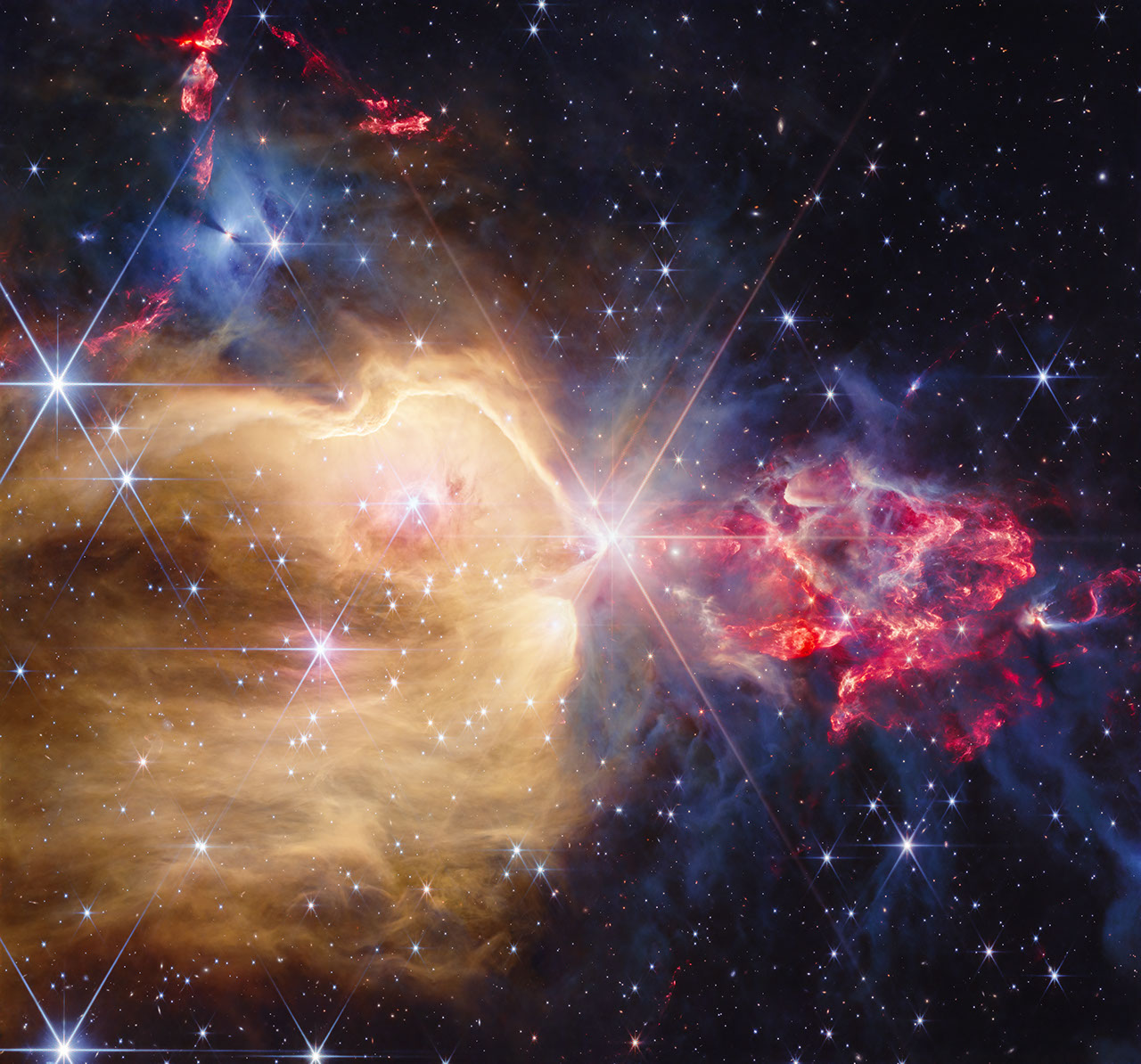
Astronomers have carried out one of the most detailed surveys to date of young star clusters, drawing on data from two of the most powerful space observatories ever built: the James Webb Space Telescope (NASA/ESA/CSA) and the Hubble Space Telescope (NASA/ESA). The study targeted four nearby spiral galaxies, cataloguing thousands of clusters at various stages of development to build a statistically robust picture of how stellar populations emerge and evolve.
The logic behind the approach is straightforward but powerful. By observing clusters of different ages within the same galaxies, researchers effectively reconstruct a timeline of cluster evolution without having to wait millions of years — each cluster serves as a snapshot of a different moment in the same life cycle.
More mass means faster escape
The central finding carries significant weight: the more massive a star cluster, the more rapidly it disperses the surrounding clouds of gas and dust from which it was born. This mechanism, known as stellar feedback, is driven by the intense radiation and stellar winds produced by the most energetic young stars. Their combined output sweeps the interstellar medium clean within just a few million years — a brief interval by any cosmic measure.
Once exposed, these clusters pour ultraviolet light across their host galaxy. That radiation is far from passive: it ionizes nearby gas, shapes the conditions under which the next generation of stars can form, and plays a role in determining which regions of a galaxy are hospitable to planet formation. The implications reach well beyond stellar physics.
NGC 3137: a nearby spiral under Hubble's gaze
Complementing this research, Hubble recently released a detailed image of NGC 3137, a spiral galaxy roughly 53 million light-years away in the southern constellation Antlia. Studded with bright star clusters, it represents an excellent nearby laboratory for studying the full cycle of stellar birth and death. At that distance, current instruments can resolve individual cluster-scale structures with enough clarity to support precisely the kind of population studies that Webb and Hubble are now conducting together.
The pairing of the two telescopes is deliberate and effective. Hubble's strengths in ultraviolet and visible wavelengths make it well suited to mapping galaxy morphology and tracing young, hot stellar populations. Webb's infrared capabilities, meanwhile, allow it to peer through the dense dust curtains that shroud the youngest and most deeply embedded star-forming regions — regions that remain invisible to Hubble alone.
What this means for planet formation
The practical reach of these findings extends to planetary science. By charting where and when gas is cleared from a galaxy, researchers can better identify the time windows and spatial environments most conducive to the formation of protoplanetary disks. That, in turn, informs broader questions about where rocky, potentially habitable planets can arise.
Taken together, these results underscore the enduring value of maintaining complementary observatories in space. Webb and Hubble were designed decades apart and for somewhat different scientific goals, yet their combined output is proving to be greater than the sum of its parts — continuously refining humanity's understanding of how galaxies build themselves, star by star.