A light show in two acts above the horizon
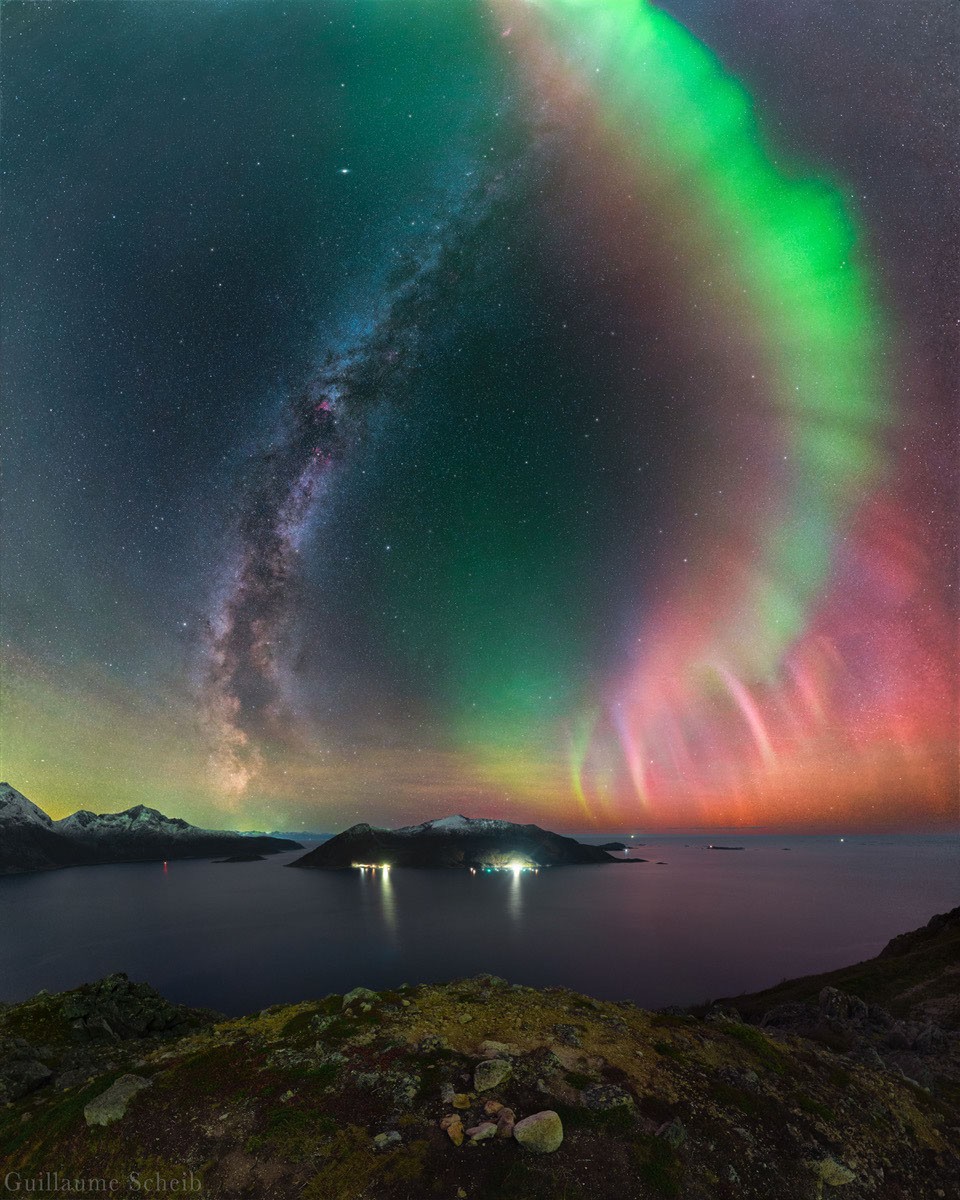
NASA's Astronomy Picture of the Day program — better known as APOD — has been running since June 1995, offering a daily curated image of the universe accompanied by commentary from a professional astronomer. On November 17, 2026, the featured photograph presented a compelling visual tension: the broad, faintly glowing band of the Milky Way stretching across a dark sky, while a northern lights display unfurled its curtains of color across the same frame.
The two phenomena could hardly be more different in origin, despite sharing the same field of view. The Milky Way's glow is the integrated light of hundreds of billions of stars distributed across our galaxy's disk, at distances ranging from a few hundred to tens of thousands of light-years. The aurora, by contrast, originates at altitudes between roughly 100 and 300 kilometers above the surface, where charged particles carried by the solar wind collide with atmospheric molecules — primarily oxygen and nitrogen — and cause them to emit light in characteristic shades of green, pink, and violet.
Capturing both in a single exposure requires a dark-sky location at high latitude, a clear night, and active geomagnetic conditions. When conditions align, the resulting image spans an extraordinary range of cosmic distances: from the near-Earth environment to the far edge of our galaxy, all compressed into a single photograph.
Webb peers inside a stellar nursery 3,300 light-years away
The day prior, on November 16, APOD turned its attention to something far more distant and structurally intricate. The James Webb Space Telescope — a joint mission of NASA, ESA, and the Canadian Space Agency — has been imaging NGC 7129, a young stellar cluster embedded in a reflection nebula within the constellation Cepheus, located approximately 3,300 light-years from Earth.
What Webb's instruments have revealed in this region goes well beyond what previous observatories could resolve. Operating primarily in the near- and mid-infrared, the telescope cuts through the dense dust clouds that have long obscured the innermost structures of star-forming regions. The latest APOD image highlights protostellar jets — high-velocity streams of material ejected by young stellar objects still cocooned in their parent molecular cloud. When these jets plow into the surrounding gas and dust, they produce shock-heated structures known as Herbig-Haro objects, long recognized as reliable signposts for the earliest phases of stellar evolution.
Webb's resolution and infrared sensitivity allow astronomers to map these jets with a level of detail that ground-based telescopes and even the Hubble Space Telescope could not achieve. Researchers can now begin to constrain jet velocities, geometries, and their feedback effects on the surrounding cloud — data that bear directly on models of how stars, and potentially planetary systems, assemble from interstellar material.
Science communication at the intersection of the near and the far
Taken together, these two APOD selections illustrate the remarkable range of phenomena that modern astronomy encompasses. One image was captured from the ground, documenting a transient atmospheric light display triggered by our own Sun. The other comes from an observatory in space, trained on a region where gravity and chemistry are actively constructing new suns.
APOD remains one of the most widely visited science outreach platforms on the internet, with each entry serving as both a public engagement tool and a gateway to peer-reviewed research. As Webb continues to deliver infrared data of unprecedented quality, the program is likely to draw increasingly from its archive. The open question hovering over NGC 7129 is a productive one: among the dozens of young stellar objects Webb has resolved in that cloud, how many are quietly assembling the ingredients for future planetary systems?