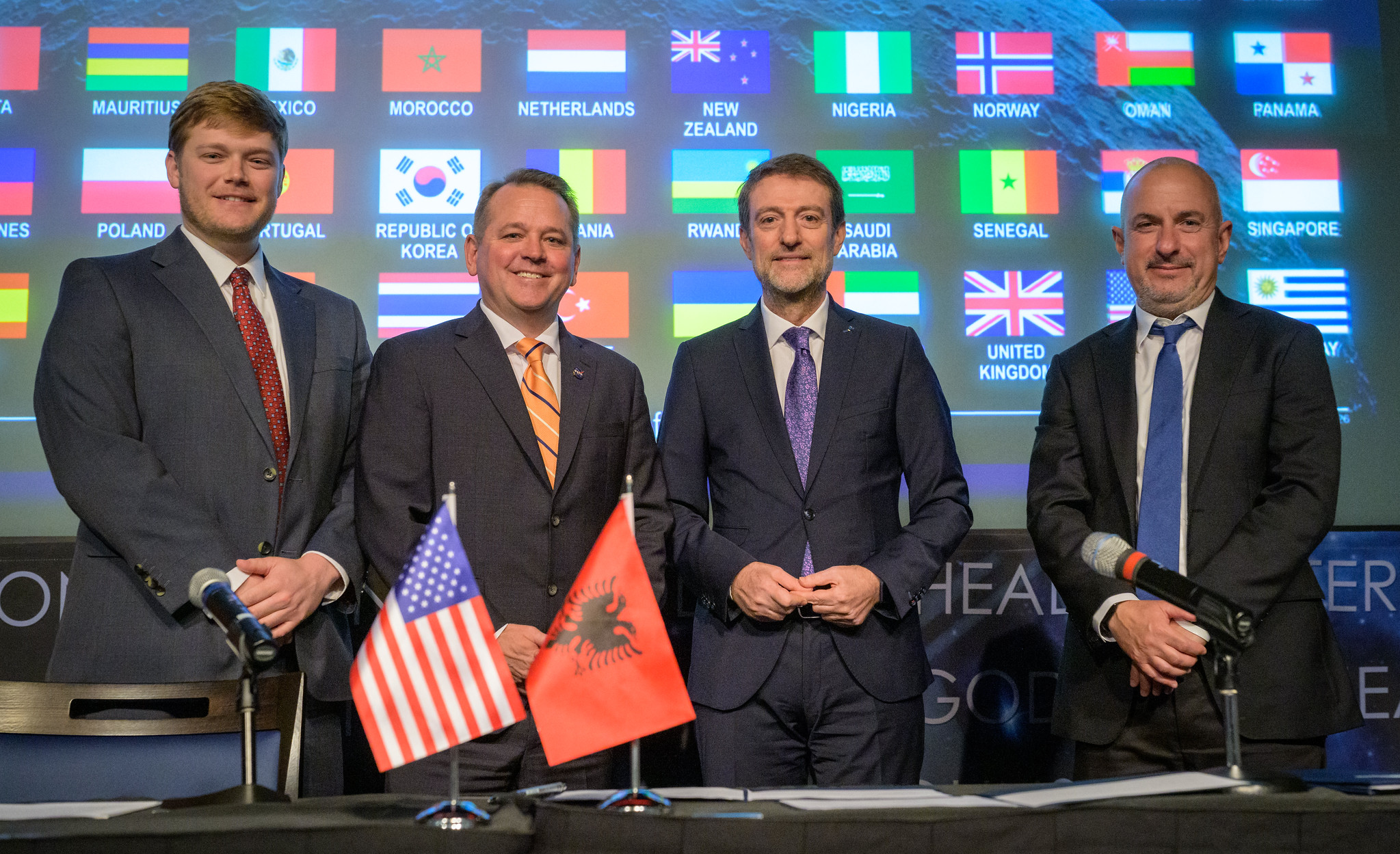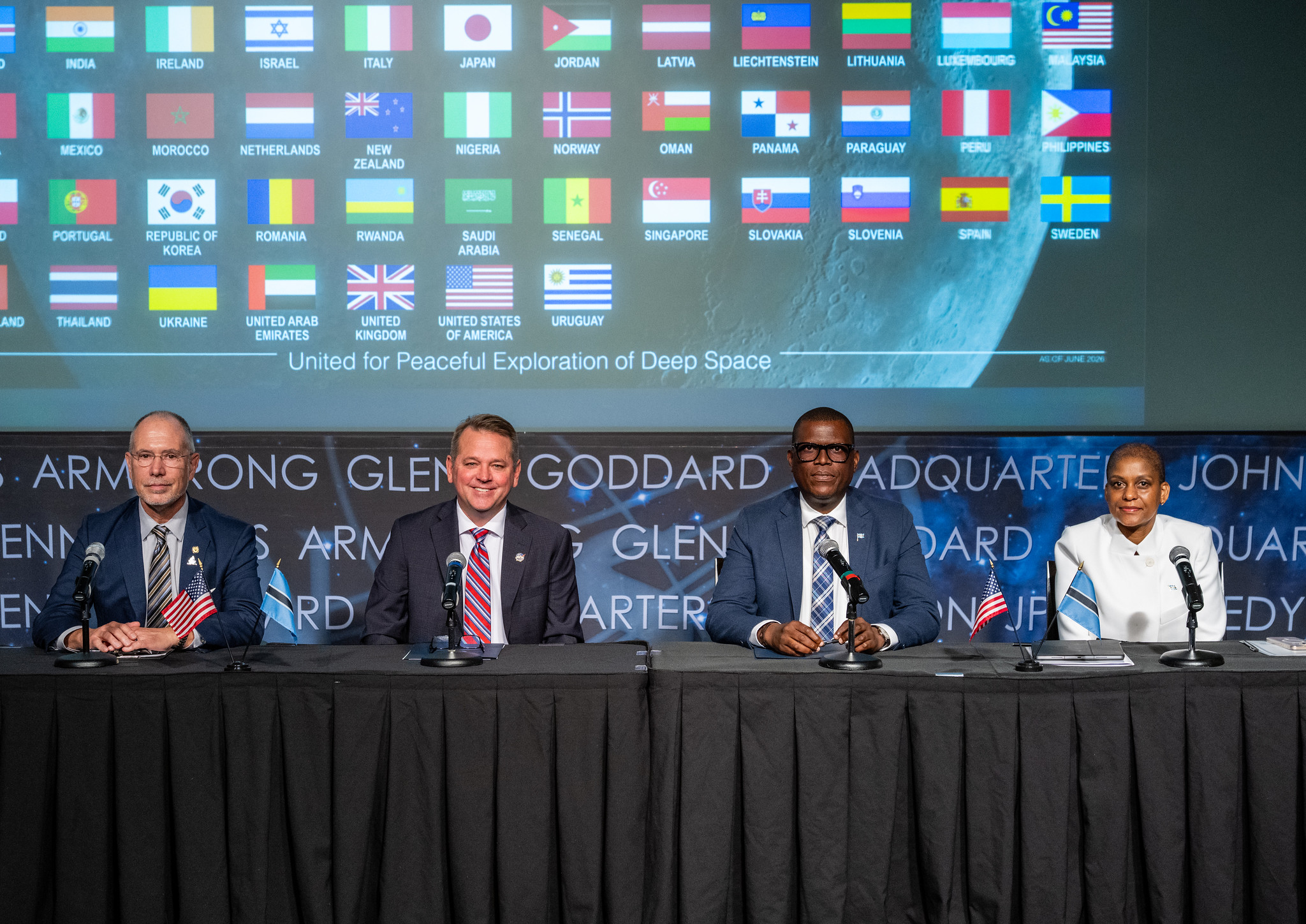
A formal ceremony at NASA headquarters
On June 25, 2026, the Republic of Botswana became the 68th signatory of the Artemis Accords during a ceremony held at NASA's headquarters in Washington D.C. NASA's Deputy Administrator welcomed the delegation, describing the occasion as a privilege and underlining the growing reach of a framework that now spans six continents. The event was jointly organized by NASA and the U.S. State Department, the two institutions that have driven the Accords since their introduction in 2020.
The Artemis Accords establish a set of non-binding principles designed to guide responsible behavior in outer space. Key provisions address transparency in space operations, the interoperability of systems used by different nations, the preservation of historically significant sites and objects in space, and the safe deorbiting of satellites at the end of their operational lives. While they remain legally distinct from the 1967 Outer Space Treaty, the Accords have become an increasingly influential coordination tool in international space diplomacy.
Africa's growing footprint in space governance
Botswana's accession brings to six the number of African nations that have signed the Artemis Accords, joining Rwanda, Nigeria, Egypt, Kenya, and Djibouti. The continent has become one of the more active regions in terms of new signatories, reflecting a broader pattern of African countries investing in space-related capabilities — from Earth observation satellites to the training of aerospace engineers and the development of national space policies.
Botswana does not yet operate a formal national space agency, but the country has shown a growing interest in satellite applications, particularly for natural resource management and environmental monitoring across its vast semi-arid territory. In this context, signing the Artemis Accords carries both a diplomatic and a symbolic weight: it signals intent to participate in the international conversation around the future of space exploration, even before establishing dedicated institutional infrastructure.
A framework with expanding reach — and persistent critics
The Artemis Accords have attracted significant support since their launch, but they remain contested on geopolitical grounds. Neither Roscosmos, Russia's state space corporation, nor China's CNSA has signed the document. Both countries have publicly characterized the Accords as a mechanism to extend American influence over space activities rather than a genuinely multilateral instrument developed through the United Nations system.
That divide has deepened as competition around lunar resources intensifies — particularly at the Moon's south pole, which NASA's Artemis program aims to reach with crewed missions in the coming years. Each new signatory reinforces the diplomatic weight of the U.S.-led coalition, even when those nations have limited direct involvement in human spaceflight programs. Whether the framework can evolve into a more inclusive governance structure, or whether it will remain a fault line between competing space powers, is a question that no single ceremony in Washington can resolve. What Botswana's signature does confirm is that more nations, across more regions, are actively choosing a side in an increasingly defined geopolitical landscape.