On consecutive days at the end of June 2026, NASA released two related solicitation documents under its NextSTEP-3 program — short for Next Space Technologies for Exploration Partnerships. Taken together, Appendix A and Appendix B sketch out a technological roadmap that the agency expects industry to help build, piece by piece, toward a sustained human foothold on the Moon.
Closing the Gaps Before Boots Hit the Regolith
Appendix A, issued in draft form on June 29, 2026, focuses on what NASA terms "lunar enabling technologies" — systems and capabilities whose readiness level must improve significantly before any operational surface deployment becomes feasible.
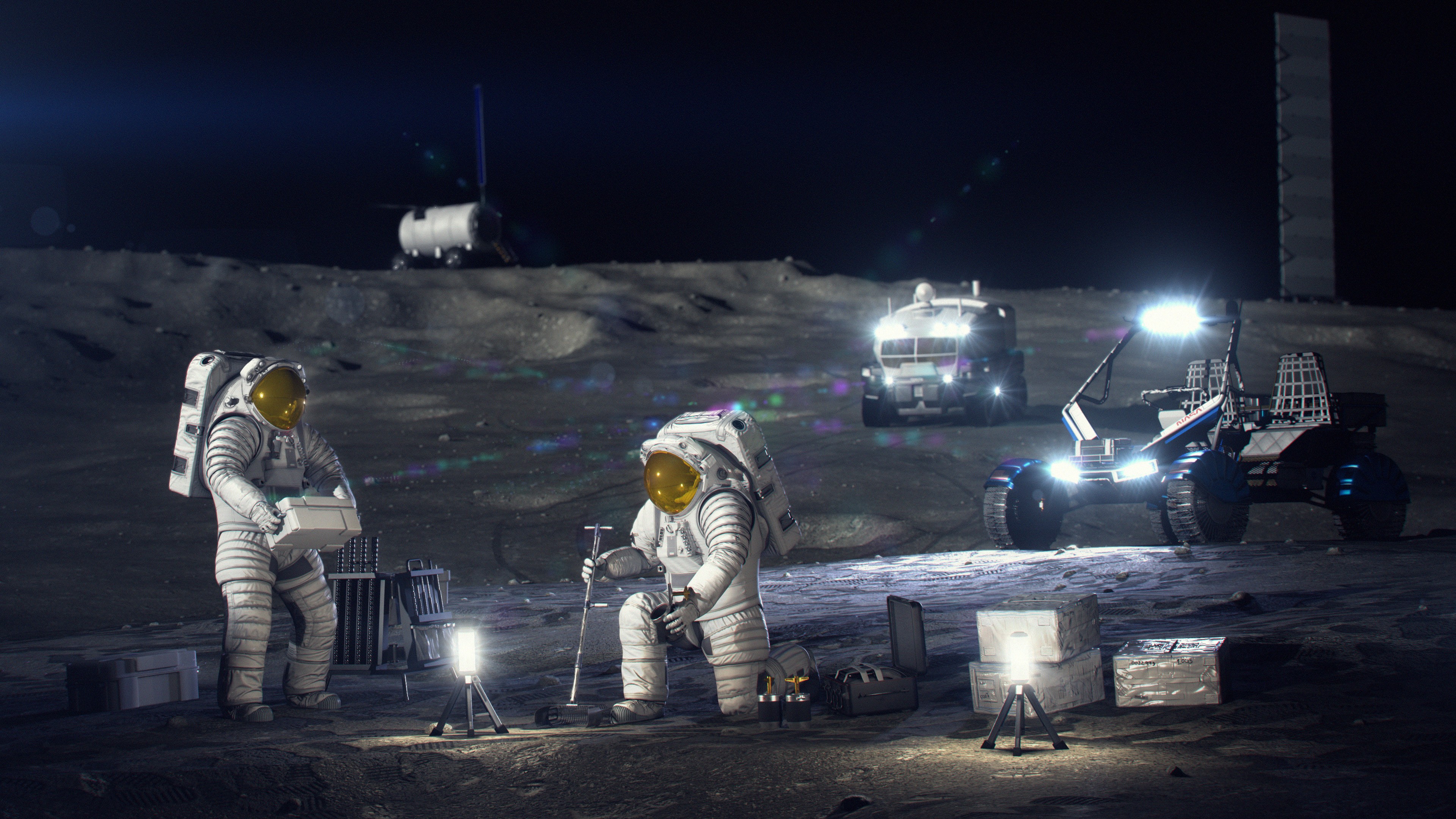
The solicitation singles out several specific areas. Vertical solar arrays, designed to capture sunlight at the low angles typical of the lunar poles, are among them. So are oxygen production systems based on In-Situ Resource Utilization (ISRU), which would extract breathable air and potentially rocket propellant directly from lunar soil and ice. Stirling radioisotope generators — devices that convert heat from radioactive decay into electricity — appear as a candidate power source capable of carrying hardware through the Moon's weeks-long nights. In-space manufacturing rounds out the list, pointing toward a future where components could be produced in orbit or on the surface, reducing reliance on resupply from Earth.
The underlying logic is straightforward: rather than committing to a single fixed architecture too early, NASA wants to raise the Technology Readiness Level (TRL) of multiple competing solutions, keeping options open for later integration decisions.
From Concepts to Real-World Demonstrations
Appendix B, published the following day on June 30, 2026, takes a broader and more operationally ambitious stance. Titled Moon Base Demonstrations, it invites companies to submit proposals for industry-led demonstrations, risk-reduction activities, and focused studies — all aimed at validating the components of a permanent crewed lunar base.
The language of the solicitation is deliberately wide-ranging. Rather than prescribing specific hardware or configurations, NASA is using the Broad Agency Announcement (BAA) format to invite genuinely novel ideas. Habitat systems, power management architectures, surface mobility, and communications infrastructure are all fair game. The implicit message is that the agency is not looking to validate a predetermined answer — it is looking for the best ones the market can offer.
That approach also reflects a broader shift in how NASA operates. Firms such as SpaceX, Blue Origin, and a growing cohort of newer commercial players have demonstrated that the private sector can move quickly and affordably. Engaging them early, through open-ended competitive solicitations, has become a central pillar of the agency's exploration strategy.
A Program Still Taking Shape
Both solicitations arrive at a moment of genuine uncertainty for the American lunar program. The Artemis initiative has faced repeated schedule revisions and budgetary pressures, and key architectural decisions — including the precise role of the lunar Gateway space station — remain unsettled within Congress and the current administration.
Against that backdrop, the NextSTEP-3 appendices serve a dual purpose. They keep industrial momentum alive by funding concrete technical work, and they preserve architectural flexibility by developing multiple parallel capabilities rather than betting everything on a single design.
As of the time of writing, neither solicitation had been released in its final form. Eligibility criteria, funding ceilings, and submission deadlines were still to be confirmed through official NASA procurement channels. Companies tracking these opportunities should monitor the agency's procurement portal closely for updates.