Lynds 1251: darkness where stars are born
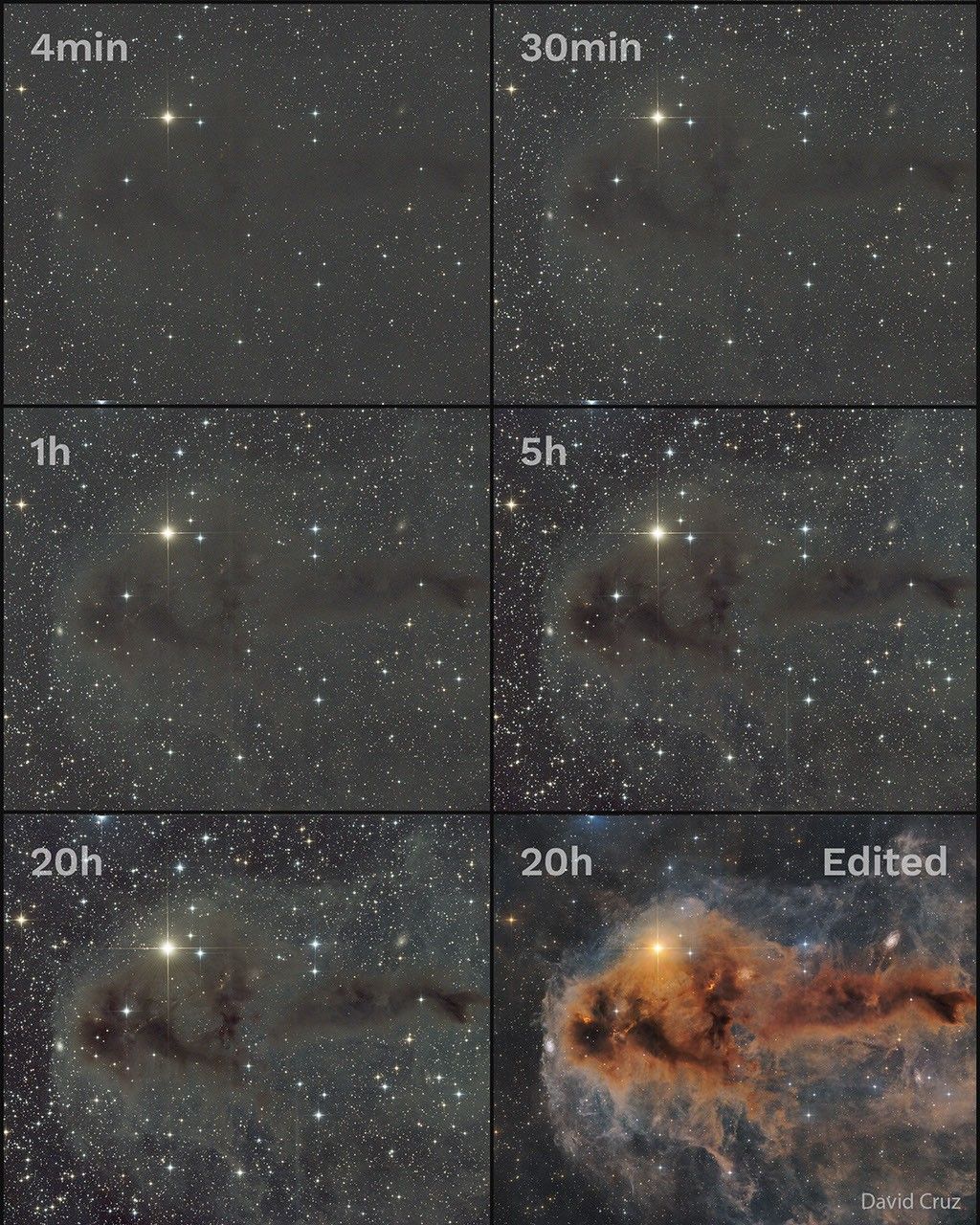
Tucked into the northern reaches of the constellation Cepheus, roughly 1,000 light-years from Earth, lies a structure that modern observatories are revealing in increasing detail: the dark nebula Lynds 1251. First catalogued by astronomer Beverly Lynds in the 1960s, this dense concentration of interstellar dust blocks background starlight so effectively that it carves a distinctive dark patch across wide-field images of the sky.
The APOD entry for November 23, 2026 focuses on what researchers describe as emergence — localized regions within the cloud where cold, dense gas has begun collapsing under its own gravity, triggering the earliest stages of star formation. Faint reddish filaments of ionized hydrogen mark these active zones along the cloud's outer edges, hinting at the energetic processes already under way beneath the obscuring dust.
Dark nebulae like Lynds 1251 serve as natural archives of the conditions that likely existed when our own Sun coalesced some 4.6 billion years ago. Infrared observatories, most notably the James Webb Space Telescope, can penetrate these opaque regions and image the protostars embedded within them — objects that optical telescopes cannot see at all.
V-G-R: a signal from the edge of everything
Three days earlier, on November 20, the APOD program highlighted something very different. The title V-G-R points directly to NASA's Voyager program, and the accompanying entry was anchored by telemetry received from one of the two spacecraft on November 17.
Launched in 1977, Voyager 1 and Voyager 2 remain the most distant human-made objects ever built. Voyager 1 is now more than 24 billion kilometers from the Sun, having crossed the heliopause — the boundary where the solar wind gives way to interstellar space — back in 2012. Voyager 2 made the same crossing in 2018, becoming only the second spacecraft to operate in the interstellar medium.
Both probes continue to function thanks to radioisotope thermoelectric generators (RTGs), which convert heat from decaying plutonium into electrical power. The instruments still active aboard each spacecraft measure interstellar plasma, cosmic rays, and magnetic fields in a region no other probe has reached. A signal from Voyager 1 currently takes over twenty-two hours to reach NASA's Deep Space Network antennas on Earth.
APOD at thirty-one: a daily window on the universe
Established in 1995 by astronomers Robert Nemiroff and Jerry Bonnell, the Astronomy Picture of the Day has grown into one of NASA's most visited online resources. Each entry pairs a carefully selected astronomical image — drawn from professional observatories, space telescopes, or skilled amateur astrophotographers — with a concise explanation written by a credentialed scientist.
These two November 2026 entries capture the program's range well. One looks inward, to a nearby stellar nursery still assembling the building blocks of future solar systems. The other looks outward, following a spacecraft that has spent decades pushing past every boundary the Solar System has to offer. Together, they serve as a reminder that astronomy operates simultaneously on the intimate and the almost incomprehensibly vast.