Lift-off from the Kazakh steppe
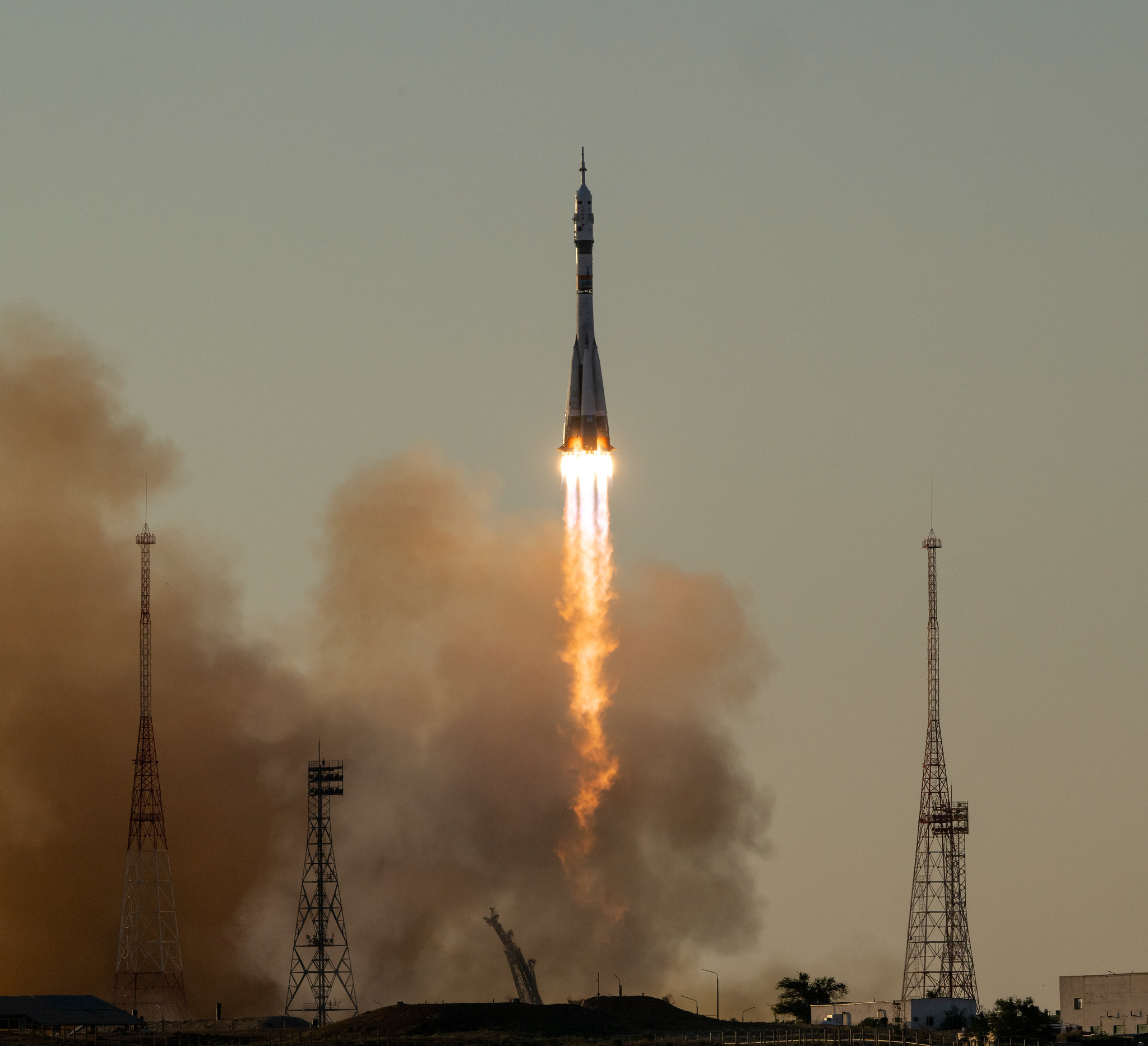
At 10:47 a.m. EDT on July 14, 2026 — 7:47 p.m. local time at the launch site — a Soyuz MS-29 rocket climbed away from the Baikonur Cosmodrome in Kazakhstan, carrying three crew members bound for the International Space Station. NASA astronaut Anil Menon flew alongside Roscosmos cosmonauts Pyotr Dubrov and Anna Kikina in what has become a familiar but operationally significant arrangement: a mixed Russian-American crew sharing a single Soyuz capsule, sustaining a pattern of direct cooperation between the two agencies even as broader geopolitical pressures continue to complicate their relationship.
Menon brings a distinctive background to this mission. Trained as a military physician, he previously served as a flight surgeon at SpaceX before NASA selected him for the astronaut corps in 2021. His seat aboard a Roscosmos vehicle is a reminder that the pathways to low-Earth orbit have grown more varied, even as the vehicles themselves remain a known quantity.
Ten people sharing one orbital outpost
Docking with the ISS proceeded without issue, bringing the station's total occupancy to ten — a figure expected to hold for roughly two weeks as crew rotation schedules align. The station is currently hosting members from the active Expedition, representing multiple partner nations and space agencies working in parallel.
A crew of ten is not unprecedented for the ISS, but it requires careful coordination across every dimension of station life: consumable resources, scientific scheduling, maintenance priorities, and contingency planning for potential spacewalks. The station, now well into its operational lifespan and officially scheduled for a controlled deorbit around 2030, continues to function as the world's only continuously inhabited microgravity research platform.
Menon, Dubrov, and Kikina will spend several weeks working alongside their Expedition colleagues before a portion of the crew returns to Earth and the headcount adjusts again.
A Soyuz seat in a changing launch landscape
At a time when SpaceX routinely ferries NASA astronauts to the ISS aboard its Crew Dragon capsule, a seat aboard a Soyuz might seem like a step back. In practice, it reflects a deliberate redundancy strategy maintained by both agencies. Cross-agency seat exchanges serve as a mutual insurance policy, ensuring that neither side loses access to the station entirely should one vehicle system face a technical grounding.
That logic has governed ISS crew planning since the earliest days of the partnership, and it has not been abandoned. Each mission to the station — regardless of the vehicle — also represents an opportunity to collect scientific data and conduct experiments that would be impossible to replicate in any ground-based facility. With the clock ticking toward the station's eventual retirement, the priority remains clear: extract as much value as possible from the platform while it is still in orbit.