Liftoff from the Kazakh Steppe
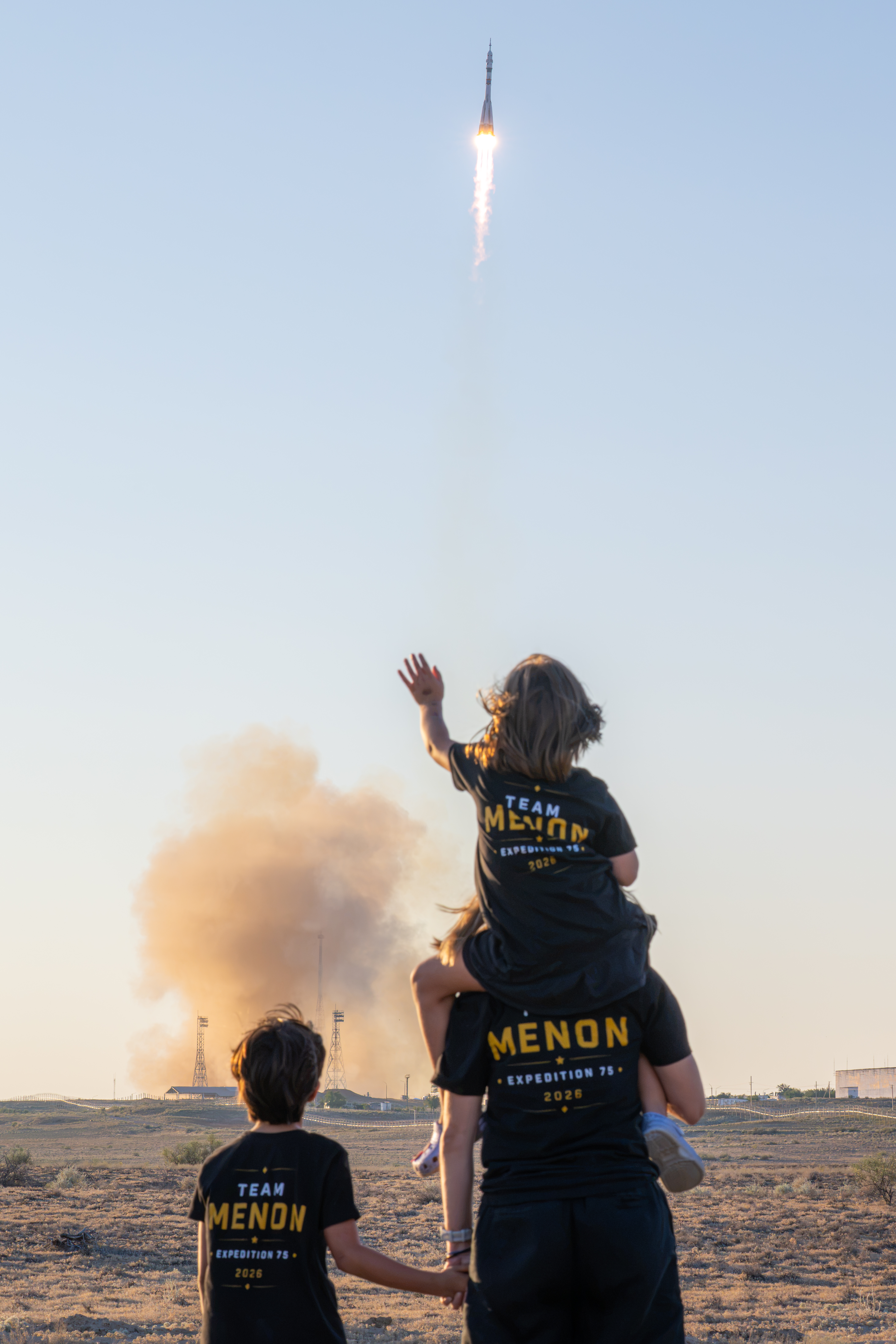
At 10:47 a.m. EDT on July 14, 2026 — 7:47 p.m. local time — a Soyuz rocket climbed away from the Baikonur Cosmodrome in Kazakhstan, carrying three crew members toward the International Space Station. NASA astronaut Anil Menon, on his first orbital flight, was joined by Roscosmos cosmonauts Pyotr Dubrov and Anna Kikina. Watching from the launch site was Anna Menon, herself a NASA astronaut candidate, alongside the couple's children — a personal snapshot of the human dimension that runs beneath the institutional mechanics of spaceflight.
The mission carries the designation Soyuz MS-29 and is part of the ongoing seat-exchange arrangement between NASA and Roscosmos. That partnership, preserved through years of geopolitical friction, remains one of the few active channels of cooperation between the two space agencies.
Ten Crew Members, One Busy Outpost
Docking was confirmed shortly after launch, and the trio was welcomed aboard by the astronauts and cosmonauts already on station. With their arrival, the ISS crew count reached ten — a level that will hold for roughly two weeks until the previous expedition returns to Earth. That figure, while not unprecedented, reflects the increasingly packed schedule of long-duration missions aboard the orbital laboratory.
Menon brings a background as an emergency physician and military pilot to his role on the mission. Before his Soyuz assignment, he had been involved in training activities connected to the Artemis program. Dubrov, for his part, returns to the ISS after a near year-long stay between 2021 and 2022, giving him a detailed familiarity with the station's systems and routines. Kikina, one of the few Roscosmos cosmonauts to have flown aboard a SpaceX Crew Dragon in 2022, adds another layer of cross-program experience to the crew.
Robots in the Making: Inside the Station's Quiet Automation Push
Away from the launch coverage, a less visible story unfolded on the same day. Icarus Robotics, a New York-based startup developing dexterous free-flying robots for use in microgravity environments, announced it had selected KULR Technology Group to supply the battery systems for Joy, its autonomous platform designed to operate inside the ISS's pressurized modules.
Free-flyers like Joy are intended to move independently through the station, handling inspection and routine maintenance tasks that currently require crew time. KULR, whose work centers on thermal management solutions for battery systems, will provide hardware rated for the specific demands of the space environment. No firm deployment timeline has been disclosed by either company.
Taken together, the arrival of Soyuz MS-29 and the incremental advance of in-station robotics point to an ISS that remains very much in active service — even as the clock ticks toward its planned deorbit, currently projected for the early 2030s. The deeper question hanging over all of it is whether the commercial stations now in development will be ready to absorb that activity before the current platform is gone.