A fragment of ancient Mars, examined slice by slice
Every meteorite that falls to Earth from another world carries a frozen record of conditions that no spacecraft has yet directly sampled. Teghaza 001 is a particularly striking example: one of the most ancient Martian rocks ever identified in any collection worldwide, it has now been the subject of detailed analysis published by NASA researchers. A thin slice of the meteorite was examined under reflected light, producing what scientists describe as a microscopic road map — a visual guide that reveals which minerals are present and where instruments should be directed for deeper investigation.
This preparatory step is far from trivial. Working with a sample of this rarity and age, researchers cannot afford to probe blindly. Reflected light imaging allows the team to locate mineralogically significant zones before committing to more destructive or time-intensive analytical techniques.
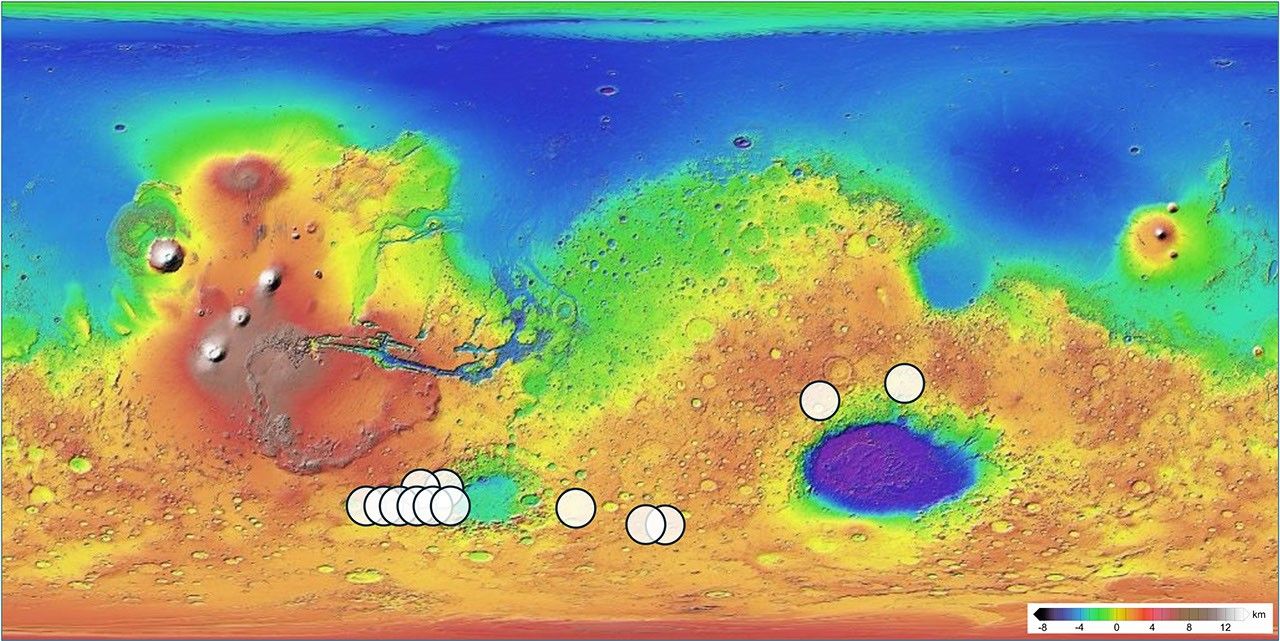
Thirteen possible birthplaces on a global map
Pinpointing exactly where on Mars a meteorite originated is, in principle, impossible. When an impactor strikes the Martian surface with enough energy to launch material into space, the ejected fragments carry no GPS tag. Nevertheless, NASA scientists cross-referenced the chemical and mineralogical fingerprint of Teghaza 001 against the orbital remote-sensing datasets accumulated by Mars missions over the past two decades, and arrived at thirteen candidate locations scattered across the planet's surface.
Significantly, those thirteen sites cluster in the southern hemisphere highlands — one of the geologically oldest terrains on Mars. The geographic coherence of the matches lends credibility to the hypothesis that Teghaza 001 broke off from Mars's primordial crust, a layer that solidified more than four billion years ago under conditions profoundly different from those on the planet today.
Deep time, and what it means for understanding early Mars
The age determination is arguably the finding that places Teghaza 001 in a category of its own. Isotopic measurements carried out on the analysed slice confirmed that the rock dates to the Noachian period, Mars's earliest geological era, broadly defined as predating roughly 3.7 billion years ago. Meteorites this old are genuinely scarce in global collections.
The majority of known Martian meteorites belong to the shergottite group, which derives from comparatively recent volcanic activity. Teghaza 001, by contrast, offers a direct physical link to an epoch when Mars may still have supported liquid water at or near its surface — a period whose environmental conditions remain poorly constrained by current data.
NASA is transparent about the limits of this work: even with thirteen candidate sites identified, no single origin can be confirmed. That uncertainty is intrinsic to this kind of planetary detective work, and it underscores the strategic importance of sample-return efforts. The Mars Sample Return programme, a joint NASA–ESA initiative whose long-term schedule remains unsettled at the time of writing, would provide ground-truth context that no amount of remote sensing or meteorite analysis can fully replicate.
What Teghaza 001 demonstrates, above all, is that Mars occasionally does the collecting for us — sending pieces of its own history across the solar system and into our hands.