In back-to-back announcements spanning just 48 hours, the James Webb Space Telescope — operated jointly by NASA, ESA, and the Canadian Space Agency — demonstrated the breadth of its scientific reach. Two sets of observations, targeting opposite ends of a star's life cycle, have given astronomers new data on how planetary systems are born and, remarkably, how some manage to endure long after their host stars have died.
FS Tau: Lifting the Veil on Stellar Nurseries
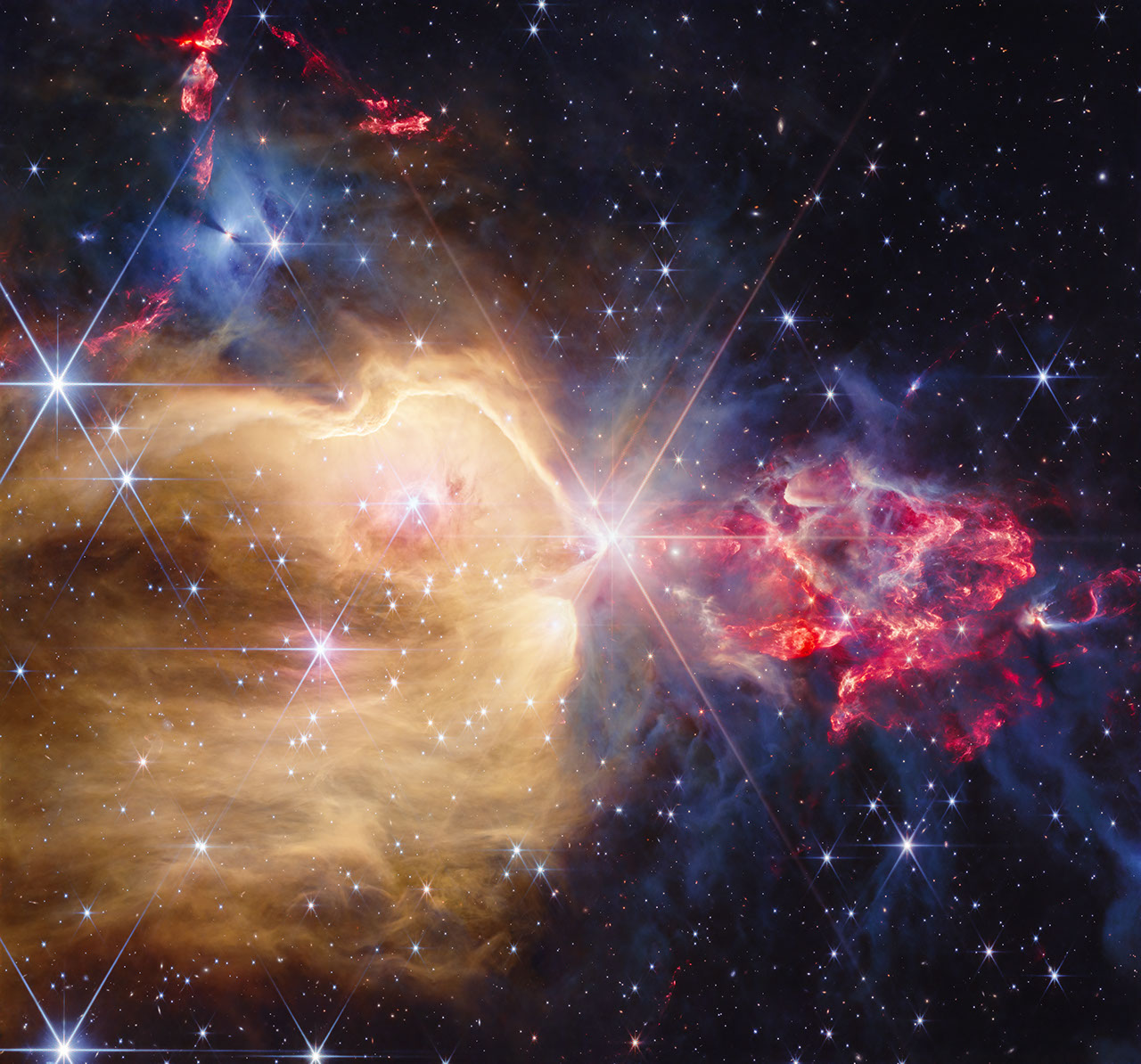
The FS Tau system, nestled within the Taurus molecular cloud, contains several young stellar objects buried deep within dense concentrations of gas and dust. Visible-light telescopes have long been unable to penetrate this material, but Webb's infrared instruments cut through it with precision, exposing structures that had never been observed before.
The resulting images show a dynamic environment: high-velocity jets of ejected material, nascent protoplanetary disks, and intricate luminous features tracing the turbulent mechanics of star formation. Dozens of background galaxies also appear in the frame, their light having traveled billions of years to reach Webb's detectors — a reminder that every pointed observation doubles as a deep-field view of the universe.
The dusty disks surrounding these infant stars are the very reservoirs from which planets eventually assemble. Studying them in systems like FS Tau helps refine models of planetary formation and offers insight into the diversity of architectures that can emerge from these early stages.
WD 1856 b: A Planet That Outlasted Its Star
At the opposite end of stellar evolution, an international research team turned Webb toward WD 1856 b, a Jupiter-sized exoplanet in orbit around a white dwarf — the dense, cooling remnant left behind when a Sun-like star exhausts its nuclear fuel, expands into a red giant, and finally collapses.
The central puzzle: how did this planet survive? A star expanding into a red giant should have consumed or violently ejected any nearby orbiting body. By tracking the planet's transits across the face of its white dwarf host, Webb enabled researchers to pin down the planet's mass and surface temperature with considerable accuracy. More significantly, the telescope detected signatures consistent with an atmosphere — the first such detection around any planet orbiting a white dwarf.
The favored explanation is that WD 1856 b did not form in its current orbit. Instead, gravitational interactions with other bodies in the system likely pushed it inward after the star's death, settling it into a stable orbit around the stellar remnant. This migration scenario carries broad implications for understanding the long-term fate of planetary systems, including our own.
One Telescope, Two Timescales, One Underlying Question
Taken together, these results highlight Webb's capacity to address some of the deepest questions in planetary science from a single platform. Within days, it illuminated both the chaotic birth of new worlds and the quiet persistence of old ones.
The thread connecting both findings is planetary resilience: under what conditions do planets form, and under what conditions do they endure? As Webb's archive of observations continues to grow, scientists are gaining increasingly granular tools to reconstruct the history of our own solar system — and to model what it might one day become. Billions of years from now, the Sun will follow the same path as the star that once hosted WD 1856 b. Whether any remnant of Earth's neighborhood survives that transition remains an open question, but Webb is steadily narrowing the range of possible answers.