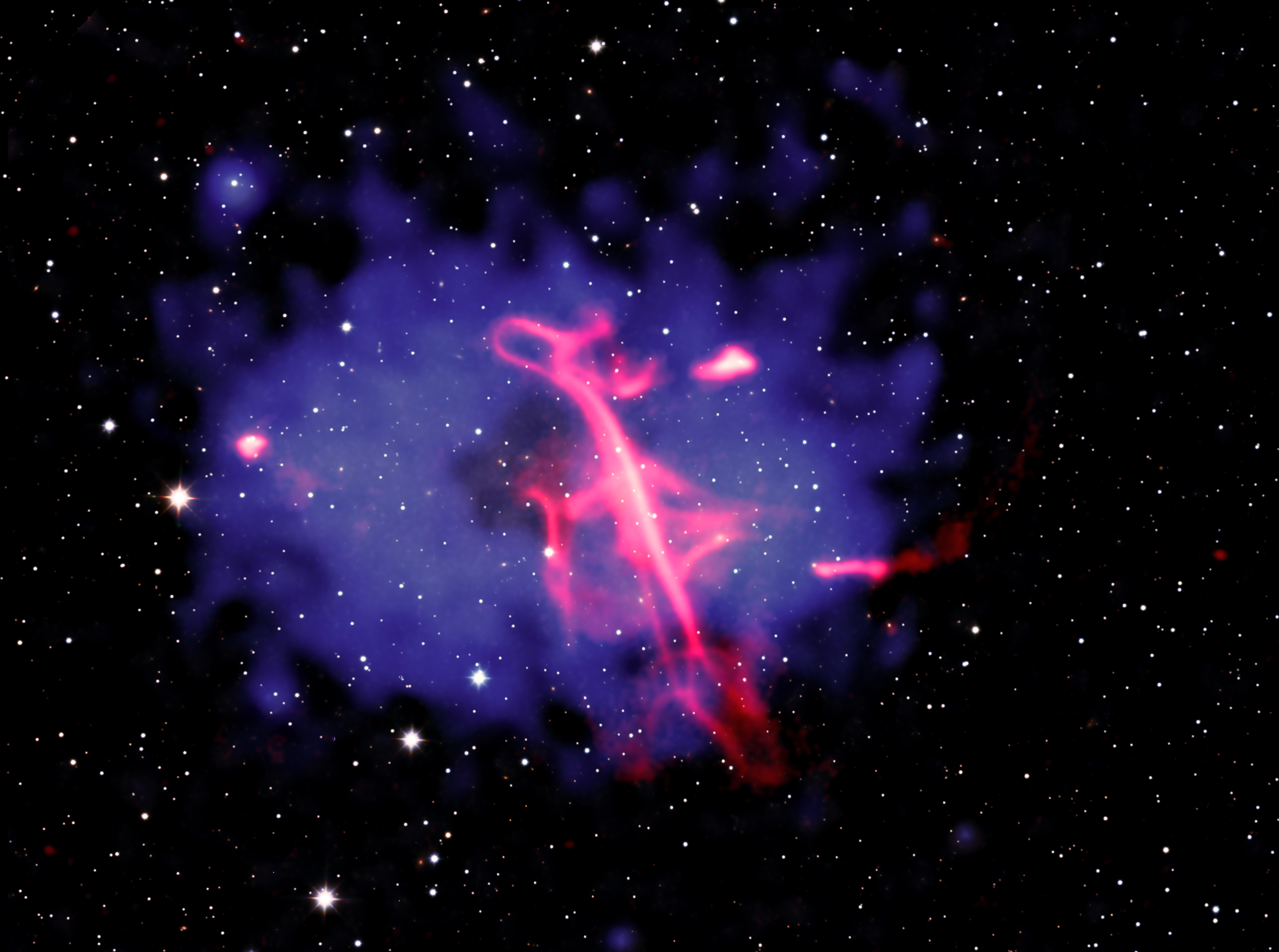
Space occasionally produces shapes that seem almost deliberate in their elegance. A formation of radio waves, observed across a region of the sky and nicknamed the "Treble Clef" for its unmistakable resemblance to the musical symbol, is one such case. Astronomers using NASA's Chandra X-ray Observatory have now put forward the most credible explanation yet for how this structure came to be — and the answer involves two of the most energetic phenomena in the known universe.
Two Violent Events, One Distinctive Shape
The leading scenario reconstructed by the research team unfolds in two acts. First, a supermassive black hole — embedded in a galaxy within one of the clusters involved — produced a powerful outburst. These eruptions, driven by matter falling onto the black hole, release enormous amounts of energy in the form of jets and lobes that push into the surrounding hot gas. This process carves cavities and leaves lasting imprints in the intracluster medium.
Then came the second act: a collision between two galaxy clusters. These are the largest gravitationally bound structures in the universe, each containing hundreds to thousands of galaxies along with vast quantities of hot gas. When two clusters merge, the resulting shock waves and turbulence can sweep through the existing radio structures and reshape them dramatically.
It is this sequence — an initial black hole eruption followed by the disruptive force of a cluster merger — that the team believes generated the Treble Clef's characteristic form. The researchers note that this interpretation is the most consistent with available data, though further observations may refine the picture.
Why Chandra Is the Right Tool for This Job
Launched in 1999, NASA's Chandra X-ray Observatory has spent over two decades mapping the hot, diffuse gas that fills the space between galaxies in clusters. This gas, heated to tens of millions of degrees, glows in X-rays — and it is precisely here that the interplay between black hole jets and cluster dynamics leaves its most readable traces.
By combining Chandra's X-ray data with radio observations, the research team was able to map where energy had been deposited and how the merger had subsequently deformed those structures. This multi-wavelength approach is not incidental: without the X-ray perspective, the physical conditions driving the radio morphology would remain largely opaque.
The Treble Clef also contributes to a broader area of research focused on giant radio structures — relics, halos, and phoenixes — that form during cluster mergers. These features are increasingly recognized as markers of particle acceleration on scales that challenge current theoretical models.
An Alignment Worth Investigating Further
Beyond its visual appeal, the Treble Clef raises a practical scientific question: how often do black hole outbursts and cluster collisions coincide in ways that produce such clearly defined radio structures? Cluster mergers are relatively common on cosmological timescales, but the geometric and temporal conditions required to yield a shape this coherent appear to be more selective.
The team plans to search for comparable structures in Chandra's archive and in data from major radio surveys, including those conducted with the Karl G. Jansky Very Large Array and the MeerKAT telescope in South Africa. If the Treble Clef proves to be one example of a broader class of objects, it could serve as a diagnostic tool for tracing the merger histories of massive galaxy clusters — and, by extension, for probing the large-scale evolution of structure in the universe.