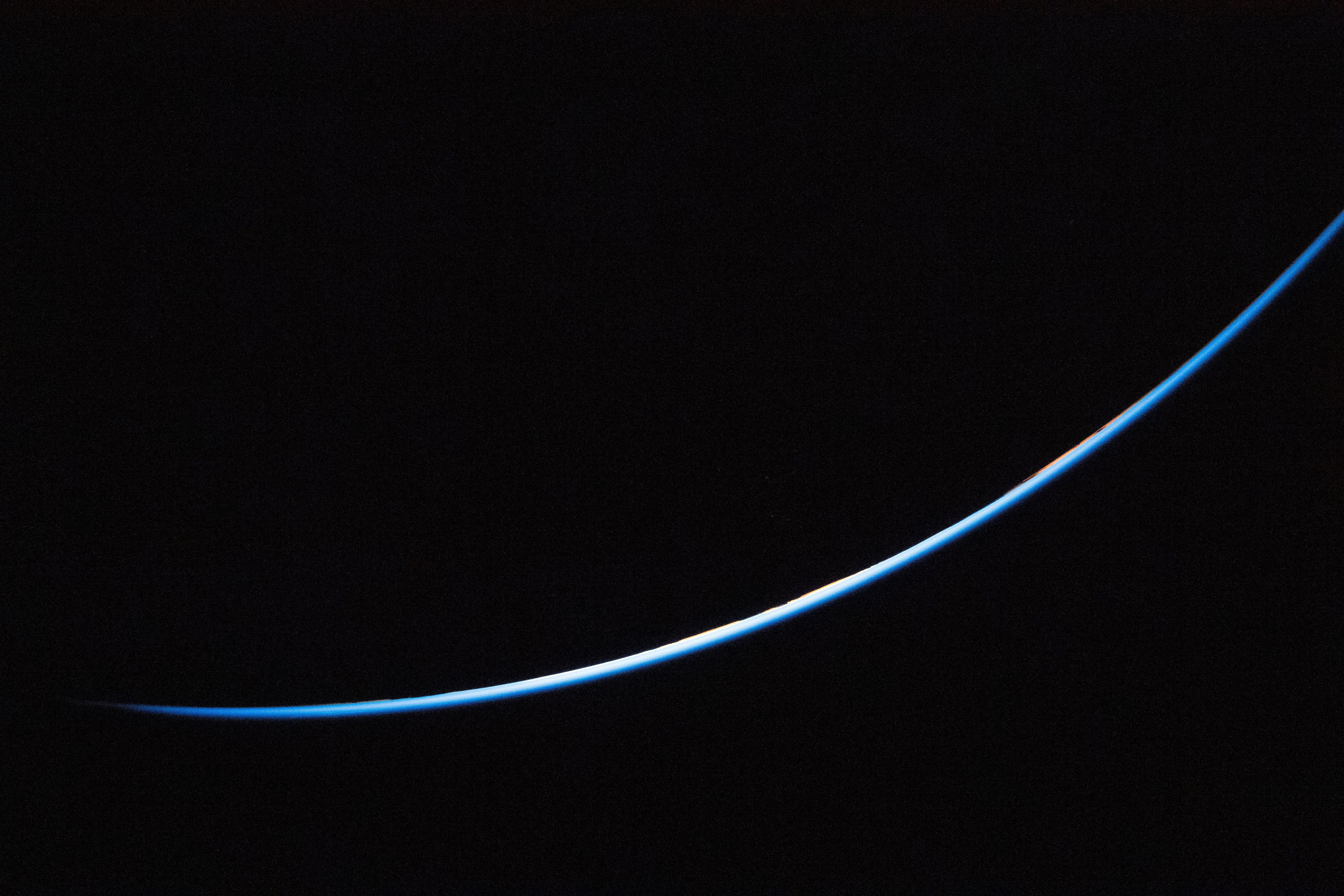
A crescent Earth from the Orion capsule
On April 3, 2026, the crew aboard NASA's Orion spacecraft during the Artemis II mission photographed the Earth as a thin arc of light against the blackness of deep space. NASA released the image publicly on May 7, framing it not as aesthetic spectacle but as evidence of a concrete milestone: the first time since the Apollo era that human beings had traveled beyond low Earth orbit.
Artemis II was not designed to land anyone on the Moon. Its purpose was operational validation — putting the Space Launch System rocket and Orion capsule through their paces with four crew members aboard, testing life support, navigation, and the full chain of deep space systems that future lunar surface missions will depend on. Artemis III, currently planned as the first crewed lunar landing since Apollo 17 in 1972, rests in part on the data gathered during this mission.
An animated version of the mission's signature image — informally called «Hello, world» by the team — also began circulating in early May. Where the still photograph captures a single frozen moment, the animation conveys the spacecraft's actual motion relative to Earth, making the orbital geometry tangible in a way the original did not quite manage. Several observers noted it adds a dimension of spatial understanding the static frame leaves implicit.
Webb turns its infrared eye on Messier 77
Forty-five million light-years from Earth, in the constellation Cetus, lies Messier 77 — also catalogued as NGC 1068. This barred spiral galaxy has been studied by astronomers for generations, but the James Webb Space Telescope has now produced its most detailed portrait yet.
The image, designated Webb's Picture of the Month for May 2026, was captured using MIRI, the Mid-Infrared Instrument developed through a partnership between NASA, ESA, and the Canadian Space Agency. Observing in the mid-infrared range allows MIRI to cut through dust rather than be blocked by it, exposing the warm material threaded through M77's spiral arms and illuminating its exceptionally bright core — a hallmark of an active galactic nucleus powered by a supermassive black hole.
The level of structural detail visible in the new image — individual dust lanes, star-forming knots along the spiral arms, the sharp gradient of the central bulge — surpasses what earlier observatories could resolve at these wavelengths. M77 is considered a benchmark target in extragalactic astronomy precisely because it combines relative closeness with an unusually rich set of physical phenomena, making it useful for calibrating models of galaxy evolution.
Same week, vastly different scales
There is something worth pausing on in the timing of these two releases. Artemis II traveled roughly the distance between Earth and the Moon and back — a few hundred thousand kilometers, a journey measured in days. The light captured by Webb from Messier 77 left that galaxy 45 million years ago, long before any human ancestor walked the Earth.
Both efforts belong to the same broader project: extending the reach of human perception and presence into the universe. NASA, ESA, and their partners are pursuing that project on multiple fronts at once — crewed missions pushing toward the Moon while orbital observatories probe structures billions of times farther away. The rest of 2026 is likely to add more chapters to both stories.