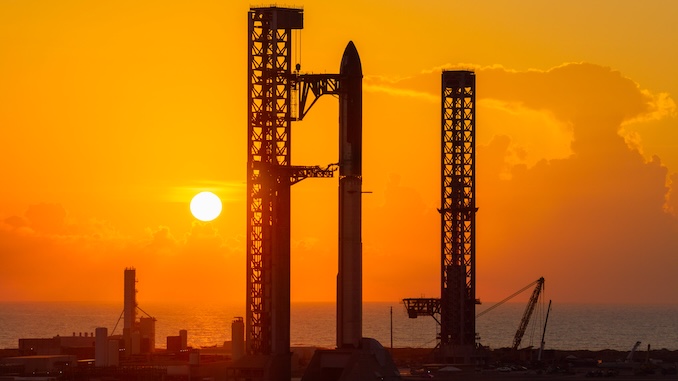
Thirty-three engines, one definitive test
On May 7, 2026, SpaceX conducted a full-duration, full-thrust static fire of Super Heavy Booster 19 at its Starbase facility in South Texas. All 33 Raptor engines ignited simultaneously, validating the propulsion stack ahead of an eventual pairing with Ship 39 for the next orbital flight attempt.
Static fires of this scale are among the most demanding qualification steps in the Starship development cycle. SpaceX must demonstrate consistent engine performance across the entire cluster before submitting documentation to the Federal Aviation Administration as part of the launch license process. Booster 19 had previously completed a series of partial engine tests, but this full-power run represents the completion of its ground qualification campaign.
Ship 39, the orbital upper stage intended to fly with Booster 19, is reportedly being readied for rollout to the launch pad. If preparations stay on track, an orbital test flight could be attempted within the coming weeks, pending regulatory clearance from the FAA.
Peak Falcon 9 — and what comes next
Away from Starbase, a quieter but equally significant shift is underway in commercial launch. Several industry analysts suggest that the Falcon 9 — SpaceX's workhorse medium-lift vehicle and the dominant launcher on the global market for nearly a decade — is approaching, or has already reached, the ceiling of its sustainable launch cadence. The booster cannot simply scale indefinitely, and the question of what fills the gap is becoming more pressing.
Rocket Lab is among the companies best positioned to benefit from that transition. The company led by Peter Beck is reporting substantial revenue growth, driven by a broadening business model that extends well beyond its Electron small-lift rocket. Rocket Lab now supplies satellite systems, mission platforms, and spacecraft components, alongside a growing portfolio of U.S. government contracts. Its medium-lift Neutron rocket, currently in development, is explicitly aimed at the segment where Falcon 9 has faced little competition.
The dynamic is notable: SpaceX is simultaneously trying to scale Starship while its Falcon 9 program reaches operational maturity, and emerging players like Rocket Lab are methodically building the capability to absorb what comes next.
A market in transition
Taken together, these developments point to an industry entering a structural turning point. Starship, if it achieves operational status, would offer a payload capacity and reusability profile that redefines what launch economics can look like. But operational status requires completing the test program, securing licensing, and demonstrating reliable flight cadence — none of which is guaranteed on any fixed timeline.
For satellite operators, government agencies, and scientific mission planners, the current period carries both uncertainty and opportunity. Access to orbit is no longer dependent on a single provider's schedule. Whether the emerging field of alternatives matures quickly enough to match sustained demand — commercial, civil, and defense — remains the central question for the years ahead.