Flying on Mars has never been straightforward. The planet's atmosphere is roughly one hundred times thinner than Earth's, forcing rotor blades to spin at extraordinary speeds just to generate enough lift to get airborne. Push hard enough, and the blade tips inevitably approach — and exceed — the local speed of sound. That is exactly the threshold engineers at NASA's Jet Propulsion Laboratory (JPL) in Southern California set out to cross deliberately, and in March 2026, they did.
Testing inside a Martian environment on Earth
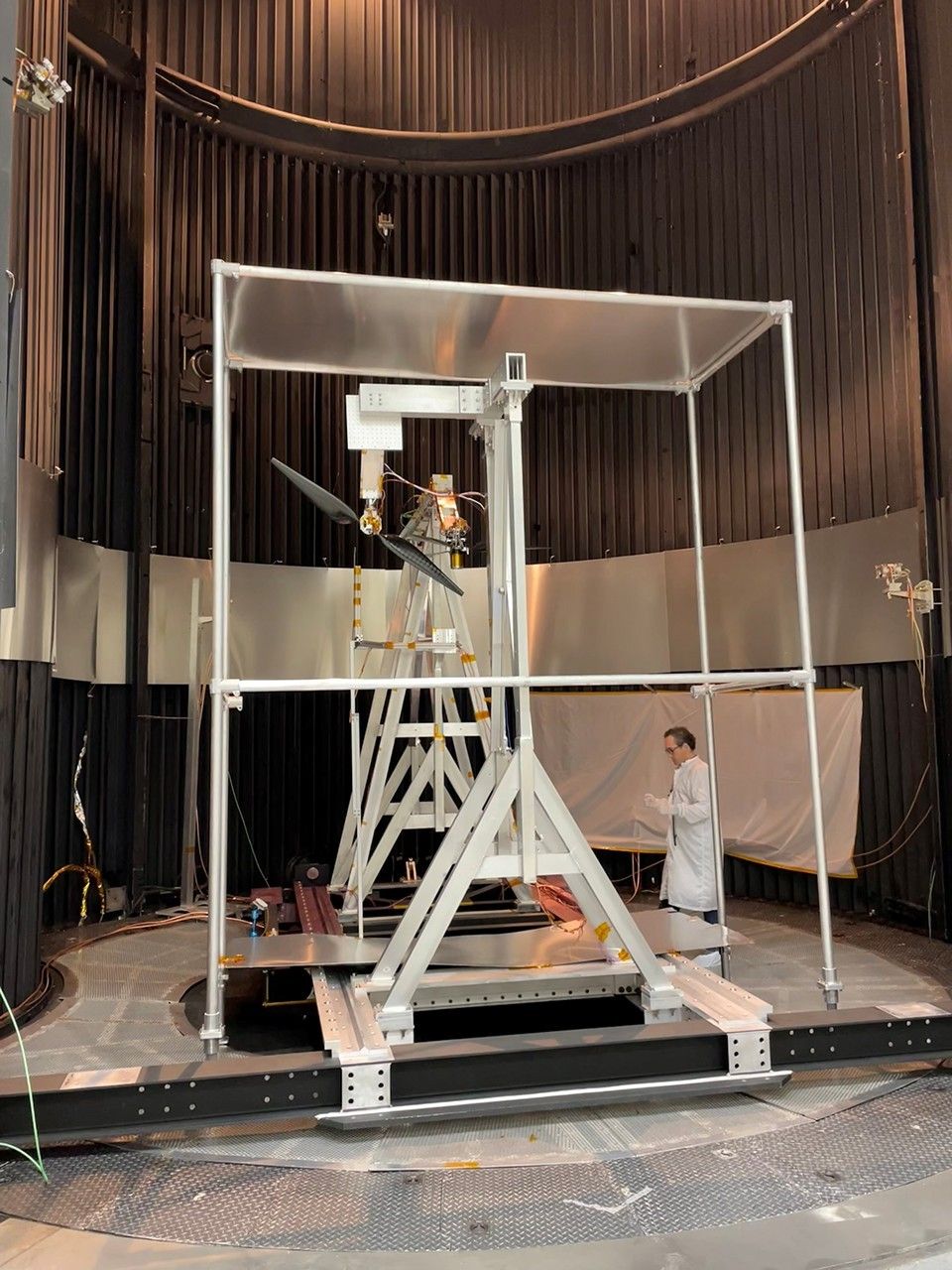
The trials took place inside JPL's 25-Foot Space Simulator, a large vacuum chamber capable of reproducing the atmospheric pressure and gas composition found on Mars. Prototype rotor blades designed for a future generation of Martian helicopters were mounted on a dedicated test stand and spun up to extreme velocities. Engineer Fernando Mier-Hicks was among those inspecting the hardware throughout the November 2025 and March 2026 test campaigns.
According to data from the tests, the blade tips exceeded Mach 1 — the speed of sound in Mars's carbon-dioxide-rich, low-pressure atmosphere, a value meaningfully different from its Earth equivalent — without structural failure. That outcome was far from guaranteed. Going supersonic produces shock waves and sharp mechanical stresses that can trigger fractures or destructive vibrations in composite materials, particularly under the thermal and pressure conditions of another planet.
Why supersonic tips are unavoidable on Mars
The track record of Ingenuity, which became the first aircraft to achieve powered flight on another world starting in April 2021, laid bare the performance boundaries of current rotor designs. Future mission concepts call for rotorcraft considerably heavier than Ingenuity — vehicles capable of carrying scientific instruments, scouting ahead of rovers, or even ferrying sample canisters. In an atmosphere as thin as Mars's, the only way to generate more lift is to increase blade area, rotational speed, or both. Either path pushes blade tips into transonic or supersonic territory.
To make that viable, the JPL team reworked blade geometry and material composition to withstand the associated loads. The March results confirm the concept: the blades held together past Mach 1, validating a design space that was previously considered off-limits for Martian rotorcraft. It should be noted that NASA has not yet formally announced a successor program to Ingenuity, and the timeline for deploying these rotors on an actual mission remains undefined.
A building block for Mars's aerial future
The milestone fits into a broader technology maturation effort tied to long-range Mars exploration planning. Several proposed mission architectures — including concepts developed in the context of the NASA/ESA Mars Sample Return program, whose schedule is still under review — rely on enhanced aerial mobility to cover terrain that ground-based rovers cannot efficiently traverse. A rotorcraft that operates reliably at supersonic tip speeds would substantially expand what is achievable from the air on Mars.
The JPL team's next steps involve refining aerodynamic models derived from the test data and assessing blade durability over extended run cycles. Breaking the sound barrier was a proof of concept, not a finish line. It marks the opening of a design envelope that engineers can now begin to explore in earnest as NASA looks beyond Ingenuity toward whatever flies on Mars next.