NASA's Psyche spacecraft executed a Mars gravity assist on May 15, 2026, using the planet's gravitational pull to adjust its trajectory and gain the momentum needed to reach its primary destination: the metallic asteroid 16 Psyche, located in the main belt between Mars and Jupiter. What might have been a purely navigational milestone also produced a series of scientifically valuable images of the Martian surface.
From a crescent planet to kilometer-scale surface detail
As the spacecraft made its closest approach, its multispectral imager first framed Mars as a thin crescent — a view captured at approximately 5:03 a.m. PDT on May 15. That image marked the last moment the entire planet fit within the instrument's field of view. As Psyche drew closer, the resolution improved significantly, allowing geologic features to emerge with increasing clarity.
Over the Syrtis Major region, a dark volcanic plain long studied by planetary scientists, the imager recorded distinctive wind streaks — elongated bright or dark features sculpted by Martian winds interacting with impact crater rims. Some of these streaks extend up to 50 kilometers in length. At this stage of the approach, image resolution reached roughly 360 meters per pixel, enough to resolve kilometer-scale structures across the terrain.
The south polar cap and Huygens crater in enhanced color
Among the most scientifically rich acquisitions, the mission team highlighted a view of Mars's south polar cap that NASA describes as the highest-resolution image of that feature produced by the Psyche mission. The cap, which holds substantial deposits of water ice, spans more than 430 kilometers across. At roughly 1.14 kilometers per pixel, the image provides enough detail to map its major structural divisions.
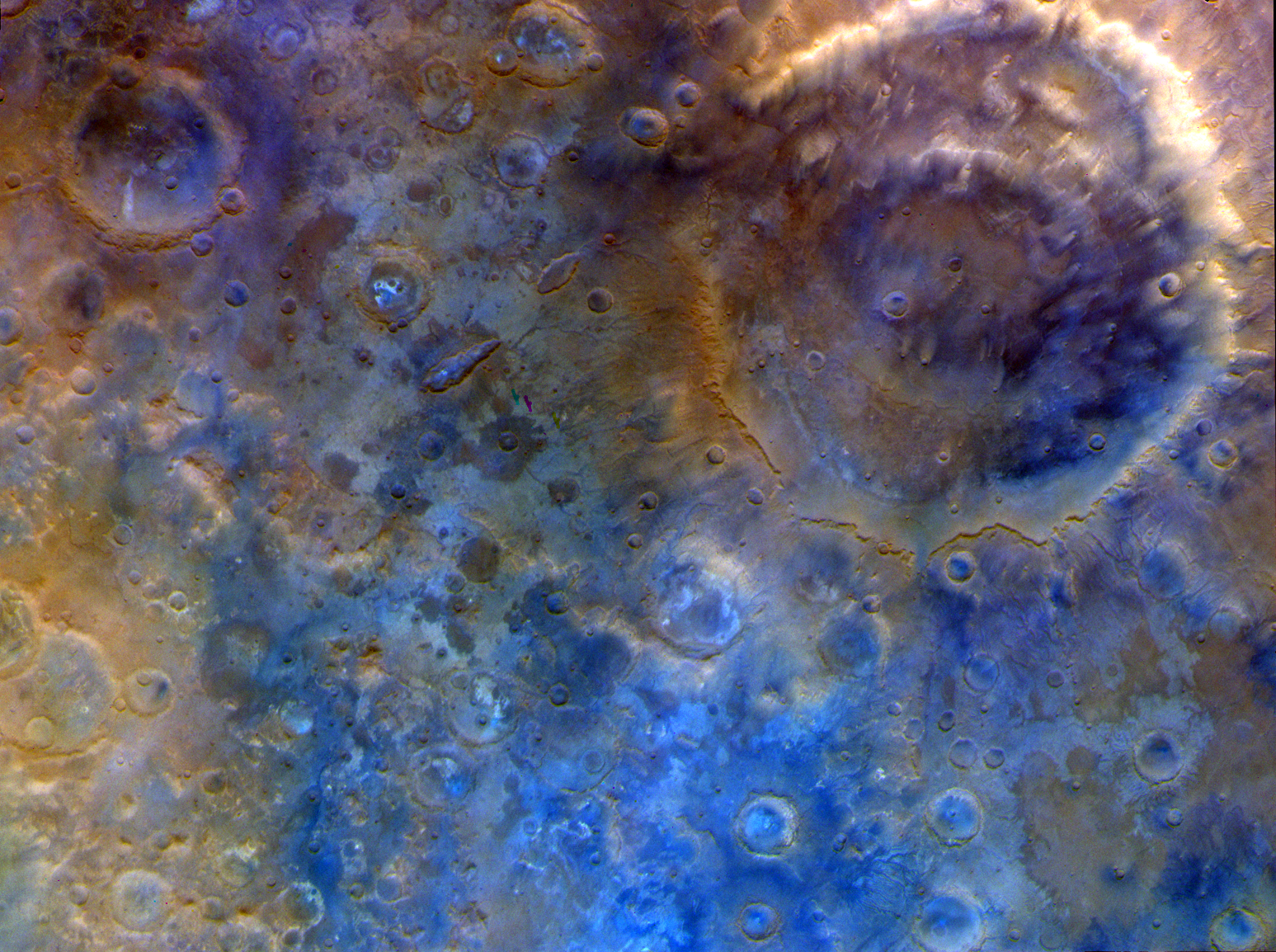
The multispectral imager also captured the southern highlands, where the large double-ring impact structure known as Huygens crater dominates the landscape at approximately 470 kilometers in diameter. Rendered in enhanced false color, the image displays a range of hues likely tied to variations in surface mineralogy or particle grain size — data that planetary geologists can use to probe the compositional history of the Martian crust.
An asteroid mission with a useful detour
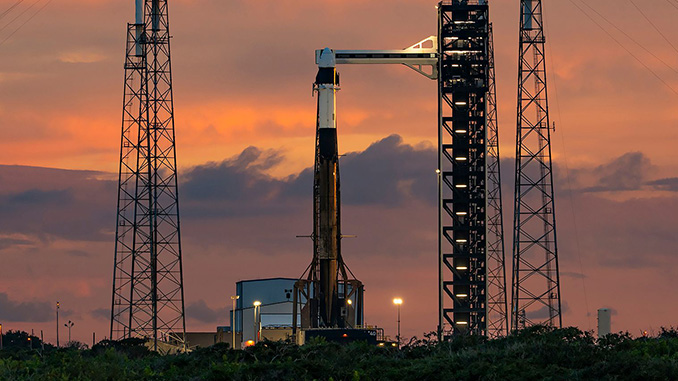
Psyche lifted off in October 2023 aboard a SpaceX Falcon Heavy rocket from Kennedy Space Center. Its central scientific goal is the in-depth study of asteroid 16 Psyche, a body thought to be largely composed of iron and nickel. Some researchers hypothesize it could represent the exposed metallic core of a differentiated protoplanet, offering a rare direct look at processes that shaped the rocky planets of the inner solar system.
The Mars flyby was not designed primarily as a science campaign, but mission engineers and scientists configured the multispectral imager to take advantage of the close passage. The resulting dataset adds to the broader catalog of Martian observations, even though it sits outside the mission's core objectives.
Psyche is expected to arrive at its target asteroid in 2029. In the meantime, the spacecraft continues its long cruise through the solar system — and, as this flyby demonstrates, the journey itself is not without scientific returns.