Gravity doing the heavy lifting
On May 15, 2026, NASA's Psyche spacecraft swept past Mars at a closest approach of 2,864 miles — roughly 4,609 kilometers — above the planet's surface. The maneuver was not a detour but a carefully engineered gravity assist, a technique in which a spacecraft borrows momentum from a planet's gravitational field to alter both its speed and the orientation of its orbital plane. The result: a meaningful velocity boost and a necessary trajectory correction, all without consuming a single gram of onboard propellant.
Psyche relies on solar electric propulsion, firing xenon ions through a set of Hall-effect thrusters. Fuel efficiency is critical on a journey of this length, and every kilogram of xenon saved translates into more operational flexibility upon arrival at the mission's true destination. Engineers at NASA's Jet Propulsion Laboratory confirmed that the flyby went as planned, with all spacecraft systems performing nominally throughout the close approach.
A camera pointed at the red planet
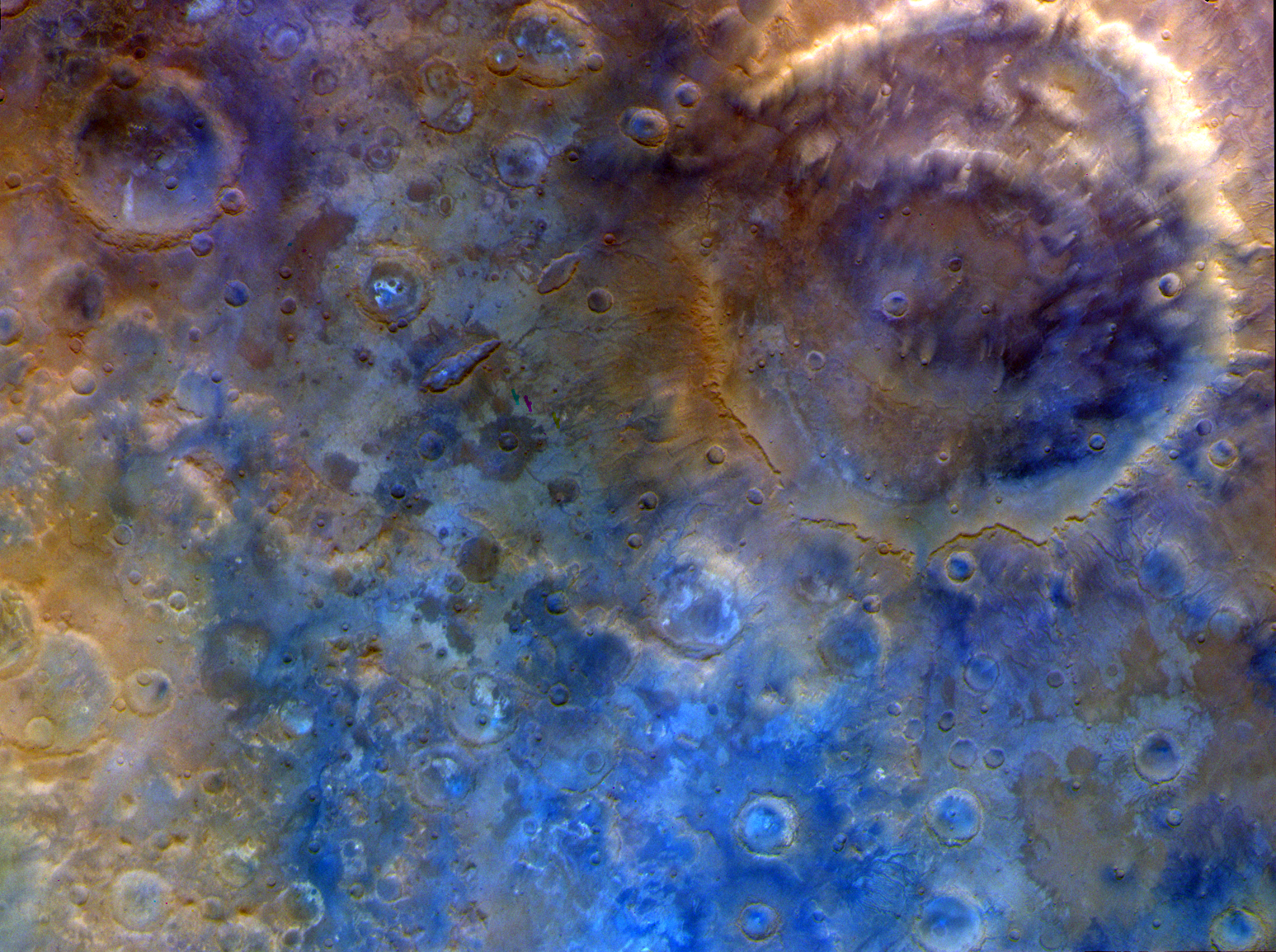
The flyby also gave Psyche's multispectral imager a rare opportunity. Shortly before and after closest approach, the instrument captured several wide-angle views of Mars. One image highlights the double-ring impact crater Huygens, set within the heavily pockmarked southern highlands — a region that preserves some of the oldest terrain on the planet. Another, taken just after the point of maximum proximity, shows what mission teams describe as a nearly full-disk view of Mars: the southern polar ice cap at the bottom of the frame, with the vast canyon network of Valles Marineris stretching toward the northern hemisphere.
While these images carry limited primary science value for a mission focused on a metallic asteroid, they serve a practical purpose: confirming the instrument's health and calibrating its performance ahead of the detailed observations it will need to conduct in the asteroid belt. NASA released both images publicly within days of the flyby.
The long road to asteroid (16) Psyche
With the Mars encounter behind it, the spacecraft has resumed firing its ion thrusters and is now on its way toward asteroid (16) Psyche, a roughly 280-kilometer-wide body orbiting in the main belt between Mars and Jupiter. Orbital insertion is expected in 2029.
The asteroid has drawn scientific interest for decades. Radar observations and density estimates suggest it is unusually rich in iron and nickel, leading some researchers to hypothesize that it could represent the exposed metallic core of a differentiated protoplanet — a body that grew large enough in the early solar system to separate into distinct layers before being stripped of its rocky mantle by repeated collisions. If that hypothesis holds, (16) Psyche would offer a direct window into the kind of interior that Earth and other rocky planets hide thousands of kilometers beneath their surfaces.
Once in orbit, the spacecraft will map the asteroid's topography, measure its gravitational field, and analyze surface composition. Whether (16) Psyche confirms, complicates, or overturns current theories about planetary cores remains an open question — and one of the more compelling puzzles awaiting resolution later this decade.