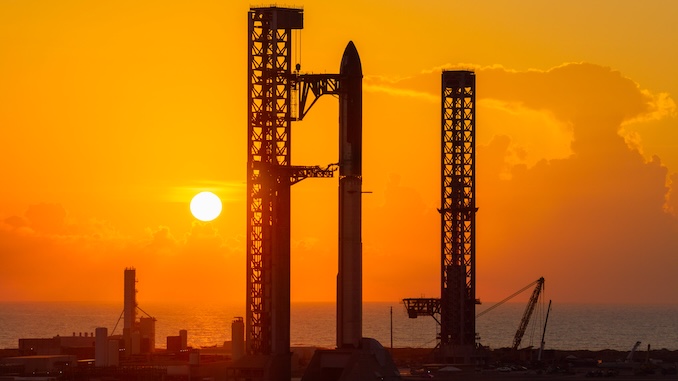
Booster 19 passes its full-power ground test
On May 7, 2026, SpaceX conducted a successful full-duration, full-thrust static fire of Booster 19 at Starbase in Boca Chica, Texas. All 33 Raptor engines ignited simultaneously, with the vehicle held down on the orbital launch mount for the complete planned duration. Static fires of this scale serve as the primary validation step before any flight attempt: they stress the propulsion system under real operating conditions while keeping the vehicle safely on the ground.
Booster 19 is paired with Ship 39, the upper stage that was preparing for its own rollout to the launch site in the days following the test. That transfer is a necessary precursor to integration checks and, eventually, stacking the two vehicles into the full Starship configuration. SpaceX has maintained a high production tempo at Starbase, fielding multiple boosters and ships simultaneously to compress the timeline between test campaigns.
No confirmed launch date has been announced for the next Starship orbital flight. The Federal Aviation Administration, which holds authority over commercial launch licensing in the United States, has not issued a public schedule for the upcoming attempt. SpaceX has characteristically declined to commit to specific timelines.
Rocket Lab posts revenue gains as small-lift demand holds firm
On the other side of the commercial launch market, Rocket Lab reported a meaningful increase in revenue, reinforcing its standing as the leading dedicated small-satellite launch provider. The New Zealand-founded, now US-headquartered company operates the Electron rocket from launch sites on both sides of the Pacific, offering fully dedicated missions to customers who require precise orbital placement on their own schedule.
That model — once viewed skeptically against the lower per-kilogram costs of rideshare launches offered by SpaceX and others — has proven durable among both institutional and commercial clients for whom schedule control and orbital flexibility outweigh sticker price. Rocket Lab is also advancing development of its mid-class Neutron rocket, targeting a first launch within the next few years, which would open access to a substantially larger payload bracket.
The company's financial momentum coincides with signs that Falcon 9's annual flight rate may be approaching a natural ceiling after years of near-continuous growth. That gradual leveling creates room for alternative providers to capture a larger share of the market.
A commercial space sector in structural transition
Read together, these two developments illustrate how the commercial launch industry is evolving beyond its early consolidation phase. SpaceX continues to press Starship toward operational status while sustaining a high Falcon 9 cadence. Rocket Lab, operating at a fraction of SpaceX's scale, demonstrates that a focused, differentiated business model can generate consistent growth.
Other players are watching closely. United Launch Alliance is ramping Vulcan Centaur, Blue Origin is expanding New Glenn operations, and Arianespace is working to establish Ariane 6 in the market. The competition is no longer purely about rocket performance — it spans economics, regulatory strategy, and long-term positioning. The week of May 7, 2026 offered a clear snapshot of where that contest now stands.