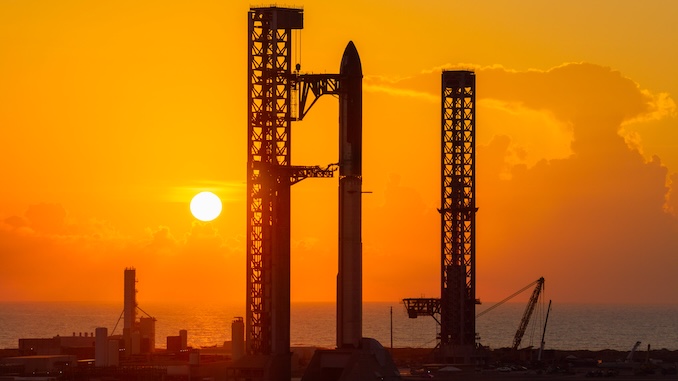
Booster 19 clears the ignition test
At SpaceX's Starbase facility in South Texas, Booster 19 — the first stage of the Starship launch system — successfully completed a full-thrust, full-duration static fire on May 7, 2026. All 33 Raptor engines ignited simultaneously, producing a level of thrust that remains unmatched in the history of rocketry. The test was held at the orbital launch mount, with the booster firmly anchored to the ground.
A static fire is designed to replicate the stresses of actual ignition without allowing the vehicle to lift off. It validates engine performance, propellant feed systems, and ground support infrastructure in conditions as close to launch as possible. Clearing this milestone is typically among the last major checkboxes before a vehicle is cleared for flight.
With Booster 19's test behind them, SpaceX teams shifted focus to Ship 39 — the upper stage that will eventually carry payloads or crew — which was being prepared for rollout to the launch site. The two milestones in rapid succession suggest the program is converging on another orbital flight attempt, though SpaceX has not announced an official target date. Industry observers broadly expect the next attempt within weeks.
Rocket Lab: revenue up, ambitions higher
On the other end of the size spectrum, Rocket Lab is posting results that reflect a company growing faster than its rocket. The New Zealand-founded, U.S.-listed firm reported a sharp increase in revenue, driven by continued Electron launches and accelerating development of its medium-lift Neutron vehicle.
Rocket Lab's financial resilience stems from a deliberately integrated business model. Rather than relying solely on launch contracts, the company generates income from satellite manufacturing, spacecraft components, propulsion systems, and mission services. That vertical integration buffers the company against the pricing pressure that SpaceX's Falcon 9 exerts on the broader launch market.
Speaking of Falcon 9 — some analysts now argue the workhorse rocket may be approaching the ceiling of its sustainable annual cadence. If that ceiling is real, it opens the door for competitors to absorb growing commercial demand that Falcon 9 alone cannot fully serve. Rocket Lab's Neutron, United Launch Alliance's Vulcan, and emerging European alternatives are all positioning for that window.
A market finding its shape
Read together, the Booster 19 test and Rocket Lab's financial performance illustrate how the commercial space sector is maturing — not as a monolith, but as a layered industry. SpaceX is pushing the ceiling of what can be lifted into orbit. Companies like Rocket Lab are demonstrating that specialized, responsive, high-value services can sustain a profitable business even alongside a dominant incumbent.
The real question is no longer whether these technologies work. Static fires and quarterly earnings reports both confirm they do. The open question is how the market stratifies over the next two to three years, as Starship moves toward operational service and Neutron edges toward its debut. The answers are close enough to see.