A planet's edge, seen from the crew of Artemis II
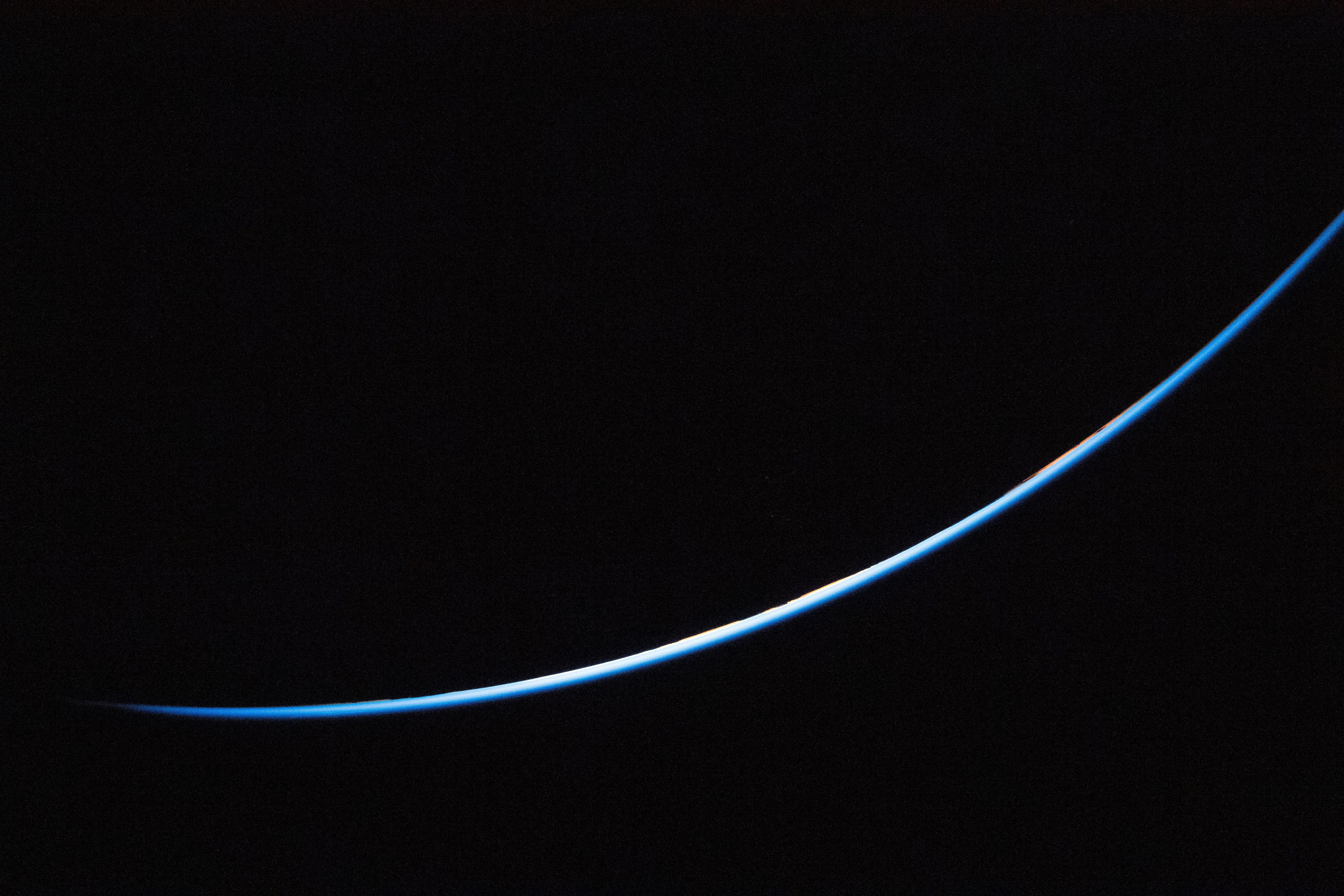
On April 3, 2026, the four-person crew aboard NASA's Orion spacecraft photographed something deceptively simple: the curved, illuminated rim of Earth, suspended against an otherwise total darkness. NASA released the image in early May, weeks after the Artemis II mission had concluded its free-return trajectory around the Moon.
Artemis II was the first crewed flight under the Artemis program, developed to restore human presence beyond low Earth orbit and eventually return astronauts to the lunar surface. The mission carried four crew members, including Canadian Space Agency astronaut Jeremy Hansen — the first non-American to fly a lunar trajectory — aboard Orion, lifted by the Space Launch System. No landing was attempted; the mission's purpose was to validate life support systems, long-range communications, and emergency procedures in real deep-space conditions.
The photograph itself carries more than symbolic weight. Taken from tens of thousands of kilometers away, it provides a direct visual record of what human observers actually see from cislunar space — data useful both to engineers assessing crew optical conditions and to a public trying to grasp the reality of where Artemis is going. The thin atmospheric glow tracing Earth's limb is a precise reminder that the envelope protecting all life is thinner, relative to the planet's size, than the skin of an apple.
Messier 77 through Webb's infrared eye
On the same day NASA released the Artemis II photograph, the joint NASA/ESA/CSA team behind the James Webb Space Telescope published their latest Picture of the Month: a mid-infrared portrait of Messier 77, a barred spiral galaxy in the constellation Cetus, roughly 45 million light-years from Earth.
M77, also catalogued as NGC 1068, has been a fixture of observational astronomy since the nineteenth century. Its particular value to researchers lies in its combination of relative closeness — making fine structural detail accessible — and the presence of an active galactic nucleus (AGN): a supermassive black hole that is actively accreting matter and radiating enormous amounts of energy across the electromagnetic spectrum.
Webb's Mid-Infrared Instrument, known as MIRI, cuts through the dust that would otherwise obscure large portions of the galaxy's disc when observed in visible light. The resulting image resolves the spiral arms with unusual clarity and renders the galaxy's bright central core — powered by that active black hole — as a nearly geometric point of light surrounded by concentric swirls of heated dust. Scientists are using this data to study star formation rates in AGN environments and the feedback mechanisms by which a central black hole can regulate — or suppress — star birth across its host galaxy.
Different distances, shared ambition
A crewed spacecraft a few hundred thousand kilometers from home, and a space telescope probing a galaxy so remote that its light left before the first hominids walked upright: these two images represent radically different scales of exploration. Yet they share a common logic. Both Artemis II and James Webb push the boundary of what human civilization can observe, reach, and understand.
Artemis II sets the stage for upcoming missions that will include lunar surface landings, while Webb continues to reframe our picture of the universe's large-scale architecture. As of mid-2026, both programs remain active, and both are producing results that warrant attention well beyond specialist circles.